How to become a real estate photographer: gear and clients
How to become a real estate photographer: the kit to start with, setting up as self-employed, what agents expect and how to deliver photos and 360 tours.
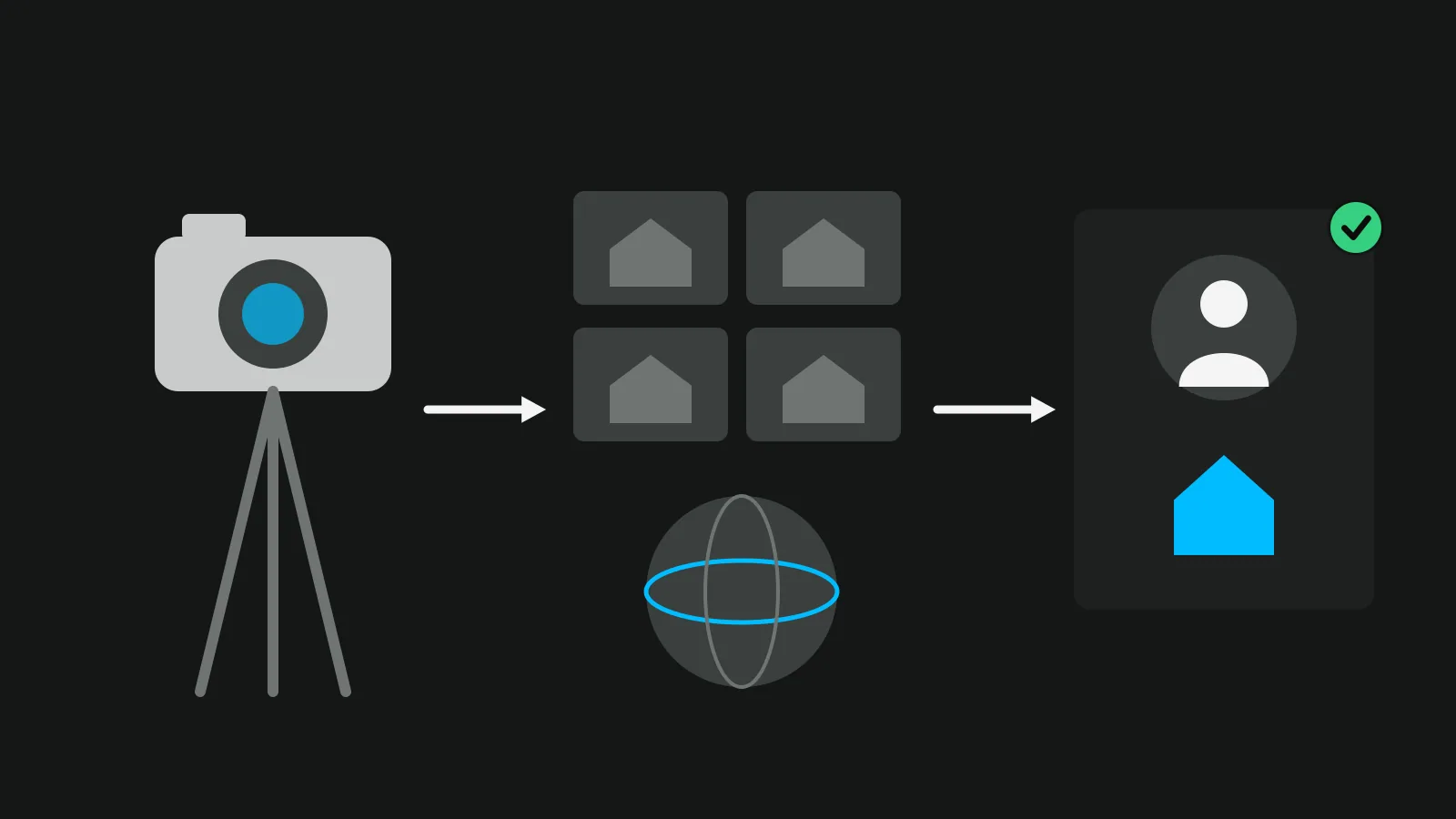
Here is how to become a real estate photographer: start with a camera, a wide lens and a tripod, shoot a few homes for a portfolio, register as self-employed, and agree with each agent what you deliver and when. Agents rebook the photographer who delivers on time, sends files they can upload straight away, and hands over a tour they keep.
This guide covers the job, the starter gear, the portfolio, the paperwork, the first clients, what agents expect and how to deliver 360 tours. For camera technique, see the real estate photography tips; prices have their own guide, linked below.
What the job is
You photograph homes for agents, and sometimes for owners, builders or holiday-let hosts, so the listing can go live quickly and look its best.
Most of the job is not pressing the shutter. A typical shoot means booking, driving, an hour or two on site, editing, delivering and invoicing. A photographer who does three shoots a day for two local brokerages, for example, spends as much time in the car and at the desk as in the homes. Plan your day, your prices and your software around that.
The work suits people who like order. Agents need the photos before the listing date, the seller wants the home shown well, and you are the person between the two.
The gear to start with
You do not need everything on day one. Start with what lets you take straight, sharp, well-lit photos of a room.
| Item | Why | Read more |
|---|---|---|
| A camera with manual exposure | You control brightness and keep it the same from room to room. A phone works for a first portfolio | Photography tips |
| A wide lens | Shows a whole room from the doorway; wide, but not so wide that the room looks distorted | Lens section of the tips guide |
| A sturdy tripod | Keeps verticals straight and lets you take several exposures of the same view | Tips guide |
| A flash | Optional at first; useful in dark rooms and for window views | HDR real estate photography |
| Editing software | Every photo needs at least a straightening and colour check | Real estate photo editing |
| Later: a 360 camera | For 360 virtual tours | 360 camera for real estate |
| Later: a drone | For large plots, views and the street | Real estate drone photography |
HDR or flash is a choice of technique, not of kit; the HDR guide explains both.
Build a portfolio before you charge
Agents hire from what they see. Before you send a price list, shoot a short set of homes:
- your own home and the homes of friends who agree;
- a holiday-let host who needs new photos;
- one local agent who agrees to a test shoot of a real listing.
Pick your best photos across room types: living rooms, kitchens, bedrooms, bathrooms, exteriors. A short, strong set beats a long one with weak photos in it. If you will sell tours, include one 360 tour.
Ask in writing for permission to use each home's photos in your portfolio. Before you publish them, check that no person, family photo or document is visible. In 360 photos, people often end up in the frame; the free Blur faces in 360 photos tool hides them.
Set up as self-employed
This is general information, not tax or legal advice.
In the US. The guides we read name no licence for photography itself, but your city or state may ask for a business licence or a sales tax registration: check with both. For federal tax, the IRS says "you have to file an income tax return if your net earnings from self-employment were $400 or more". Flying a drone for a client counts as commercial flying and needs a Part 107 Remote Pilot Certificate; our drone photography guide explains how to get one.
In the UK. GOV.UK says "you must register for Self Assessment as a sole trader if you earn more than £1,000 in a tax year". You can start trading before you register, but you must keep records from the day you start.
Insurance. Several guides recommend general liability insurance, and some add errors and omissions cover. No rule requires a specific policy that we could find, so ask an insurer what covers you on a client's property and what covers your gear.
Your licence terms. Decide before the first shoot what the agent may do with your photos: one listing, any marketing, for how long. The rules on who owns the photos are in who owns the photos you paid for.
Find your first agents
Start close to home. Look for:
- the local brokerages and the agents with the most listings in your area;
- new agents, who need photos and often have no photographer yet.
Show them work they recognise: homes in their area and in their price band. Offer one test shoot of a real listing, not free work for months. After the test, make rebooking easy: confirm bookings the same day, send a calendar link and a clear price list. To build that price list, use the formula in real estate photography pricing, in the section for photographers.
What agents expect: your delivery sheet
Tell agents exactly what they get and when. Put it in writing and send it with your first quote:
| Item | What to agree |
|---|---|
| Turnaround | A delivery time you can always meet. One guide, The Close, names "a 24- to 48-hour window" for edited photos |
| Number of photos | How many, for which size of home |
| Order | Shoot order: exterior, living areas, kitchen, bedrooms, bathrooms, outside space |
| Sizes | Two sets: one sized for the portal or MLS, one at full size. Ask the agent which size their MLS or portal wants and whether logos or watermarks are allowed on listing photos |
| File names | Names that say the room ("03-kitchen.jpg"), and no location data in the files: the free Photo metadata remover strips it |
| Edits | What you fix (verticals, windows, skies) and what you will not change without a label; see edits you may make, and edits you must disclose |
| Licence | One sentence on what the agent may do with the photos |
| Re-shoots | When you come back, and at what cost |
| 360 tour | How you deliver it (next section) |
A clear sheet saves both of you questions, and it is easy for the agent to forward to the seller.
Delivering 360 tours that the agent keeps
When you sell 360 tours, the agent will ask one question sooner or later: whose tour is it? The link sits on portals, flyers and QR codes, and the enquiries should reach the agent. Vistura gives you two ways to deliver:
| How | Who publishes | Who gets enquiries and statistics | The link |
|---|---|---|---|
| You edit inside the agent's account | The agent | The agent | The agent's link from the start |
| You build it in your account and hand it over | The agent, after accepting | The agent, past ones included | Stays the same |
You edit inside the agent's account. The agent invites you with "Share for editing", up to 5 people per tour. You edit photos, rooms and content, and you do not need a paid plan; publishing, leads and statistics stay with the agent. Inviting editors is a Pro feature on the agent's side.
You build it in your account and hand it over. "Hand over to another account" works on every plan: the tour, its link, leads and statistics go to the agent's account, and visitors notice nothing because the link stays the same. On Pro, or in their agency's team, the tour always fits; an agent on Free receives it while fewer than 3 of their tours are online. Nothing changes until the agent accepts. Tick "Keep editing access" if you may need to replace photos later; the new owner can remove it. The agent chooses "Where it goes": their own space or their agency's team, where on Business the tour takes the agency's brand and domain.
Your regular photos can sit in the same tour as a "Regular photo (not 360°)" stop, so the agent shares one link for everything. Tours you already made in another tool come in as a .zip (Marzipano, krpano, Panoee). Every new account starts with 14 days of Pro, no card needed, and on Pro the tour shows the agent's own logo and colours: see the plans. The steps to build a tour are in how to make a virtual tour.
Free tools for the edit
These run in the browser: free, no account, no watermark.
- Fix vertical lines for walls that lean in.
- Straighten a 360 photo for a crooked horizon.
- Nadir patch (remove the tripod) for the tripod at the bottom of a 360 photo.
- Blur faces in 360 photos for people and family photos.
- Photo metadata remover for GPS positions before delivery.
- Watermark real estate photos for proofs you send before payment.
- Compress a 360 photo for files too heavy to upload.
Inside a Vistura tour, "Straighten" is built into each photo's settings on every plan, and on Pro the tripod is erased using the floor around it or covered with a colour or the agent's logo. Photos you upload to a Vistura tour also lose their camera metadata, GPS position included, on every plan, and Vistura makes the lighter versions for phones itself for any photo up to 25 MB. For the editing method itself, see real estate photo editing.
A first-month checklist
- Gear basics: camera, wide lens, tripod, editing software.
- A short portfolio of your best photos, each home used with written permission.
- Registered: in the US, check your city and state and the IRS rule; in the UK, Self Assessment above £1,000.
- An insurer asked about cover on site and for your gear.
- A price list.
- A delivery sheet to send with every quote.
- A drone only once you hold the certificate.
- One way chosen to deliver 360 tours.
The photographer who gets rebooked is the one whose files and tours are ready when the agent needs them.
Frequently asked questions
Do you need a license to be a real estate photographer?
Not for taking the photos, in the guides we read. What you may need is local: a business licence or a sales tax registration from your city or state. The one federal certificate is for drones: flying for a client needs Part 107.
Do you need a drone to start in real estate photography?
No. Most listings need interior and exterior photos first. Add a drone later, once you hold the Part 107 certificate; our guide to real estate drone photography explains the rules, and an insurer can tell you what covers a drone on a client's property.
Should a real estate photographer offer 360 tours?
It helps when the agents you work with use tours, because they can book one photographer for both. Agree how you deliver the tour before the shoot, so the agent keeps the link and the enquiries.
How long does it take to get your first real estate clients?
It depends on your portfolio and the agents near you. A test shoot with one agent who has regular listings is the usual start, and rebookings come from delivering on time.