Sun path calculator for a home: hours of sun on each side
See the sun path and sun exposure of a home on any day: when the sun rises and sets, and how many hours of direct sun each side, balcony or yard gets. Free, no account.
Your location and photos stay on your deviceFree, no accountUpdated
Sun path in New York
- Sun on the chosen side
- Chosen day
- 21 June
- 21 December
- Equinox
At 3:00 PM the sun is in the south-west (245°), 59° above the horizon. It shines on the south side.
Sunrise 5:25 AM · solar noon 12:57 PM · sunset 8:30 PM · daylight 15 h 06 min
Where is the home?
New York, United States40.7130° N, 74.0060° W · America/New_York
Cities of the US, Canada, Europe and Latin America, and major cities worldwide. The location stays on your device.
Time zone: America/New_York
Set from the nearest city. Change it if the home is across a time zone border.
Which way does the side face?
The direction you look in from the window, balcony or yard. Drag the blue handle on the rose, or pick one:
Faces south
Hours of direct sun on the south side (180°)
| Day | Daylight | Sun on this side | When |
|---|---|---|---|
| June 21 · longest day | 15 h 06 min | 7 h 58 min | 9:00 AM–4:56 PM |
| March 20 · equinox | 12 h 09 min | 12 h 00 min | 7:04 AM–7:02 PM |
| December 21 · shortest day | 9 h 15 min | 9 h 12 min | 7:20 AM–4:30 PM |
Calculated for an open horizon: these are the hours the side gets without buildings, trees or hills in the way.
All eight sides
| Facing | June 21 | March 20 | December 21 |
|---|---|---|---|
| North | 7 h 04 min | 0 h 06 min | none |
| North-east | 6 h 22 min | 3 h 50 min | 1 h 18 min |
| East | 7 h 30 min | 6 h 02 min | 4 h 36 min |
| South-east | 8 h 40 min | 8 h 14 min | 7 h 52 min |
| South | 7 h 58 min | 12 h 00 min | 9 h 12 min |
| South-west | 8 h 40 min | 8 h 16 min | 7 h 54 min |
| West | 7 h 32 min | 6 h 04 min | 4 h 36 min |
| North-west | 6 h 22 min | 3 h 52 min | 1 h 20 min |
See the sun's path in a 360 photo of the room
Load a 360 photo of a room and the day's sun path is drawn over it, with the hours, so you can see through which window the sun comes in and when. The photo is opened on your device and not sent anywhere.
Show buyers where the sun comes in
In a Vistura tour each room is a 360 photo. Put an information text on the south window with its hours of sun, and buyers read it where they are looking.
Next step for this listing
- Work out the home's area room by room for the listing.
- Look around a 360 photo of the room before it goes in the tour.
- Brighten the dark rooms in your listing and 360 photos.
Free account, no card. Free plan: 3 tours online at a time, with Vistura branding.
To see the sun exposure of a home, you need three things: where the home is, which way each side faces, and the day. Pick the city or use your location, turn the compass rose to the direction the front, the living room windows or the yard face, and choose a day. The sun path diagram shows the sun's arc across the sky that day, with the arcs of 21 June and 21 December for the longest and shortest days. The table gives the hours of direct sun on that side, and when they start and end, on the solstices, the equinox and the day you chose. Load a 360 photo of a room to see the sun's path drawn over it, so you can tell through which window the sun comes in at 3 pm in December.
Made by Vistura, the virtual tour platform for estate agents
| Location | A city from the list, your device's location, coordinates you type or paste, or the GPS position in a photo of the home. |
|---|---|
| Facing | The direction a side faces: drag the compass rose, pick one of eight directions, type degrees, or hold your phone at the window and use its compass. |
| Days | Any date, plus 21 June, the March equinox and 21 December side by side. Times in the place's time zone, daylight saving time included. |
| Results | Sun path diagram, sunrise, sunset, solar noon, day length, and the hours of direct sun on each side with their times. |
| 360 photo | The sun's path over a 360 photo of a room, with hour marks. North comes from the photo's compass heading (GPano) when it has one, or you set it in a few seconds. |
| Accuracy | NOAA's solar equations: about a minute and a fraction of a degree. The hours of sun are for an open horizon: without buildings, trees or hills in the way. |
| Privacy | Runs in your browser. No map service, no lookup: the location and the photos are not sent anywhere (Privacy policy). |
| Price | Free, no account. |
Show buyers where the sun comes in
Vistura is virtual tour software for real estate. Each room of the home is a 360 photo, and an information text on a window can tell buyers when the sun comes in, right where they are looking.
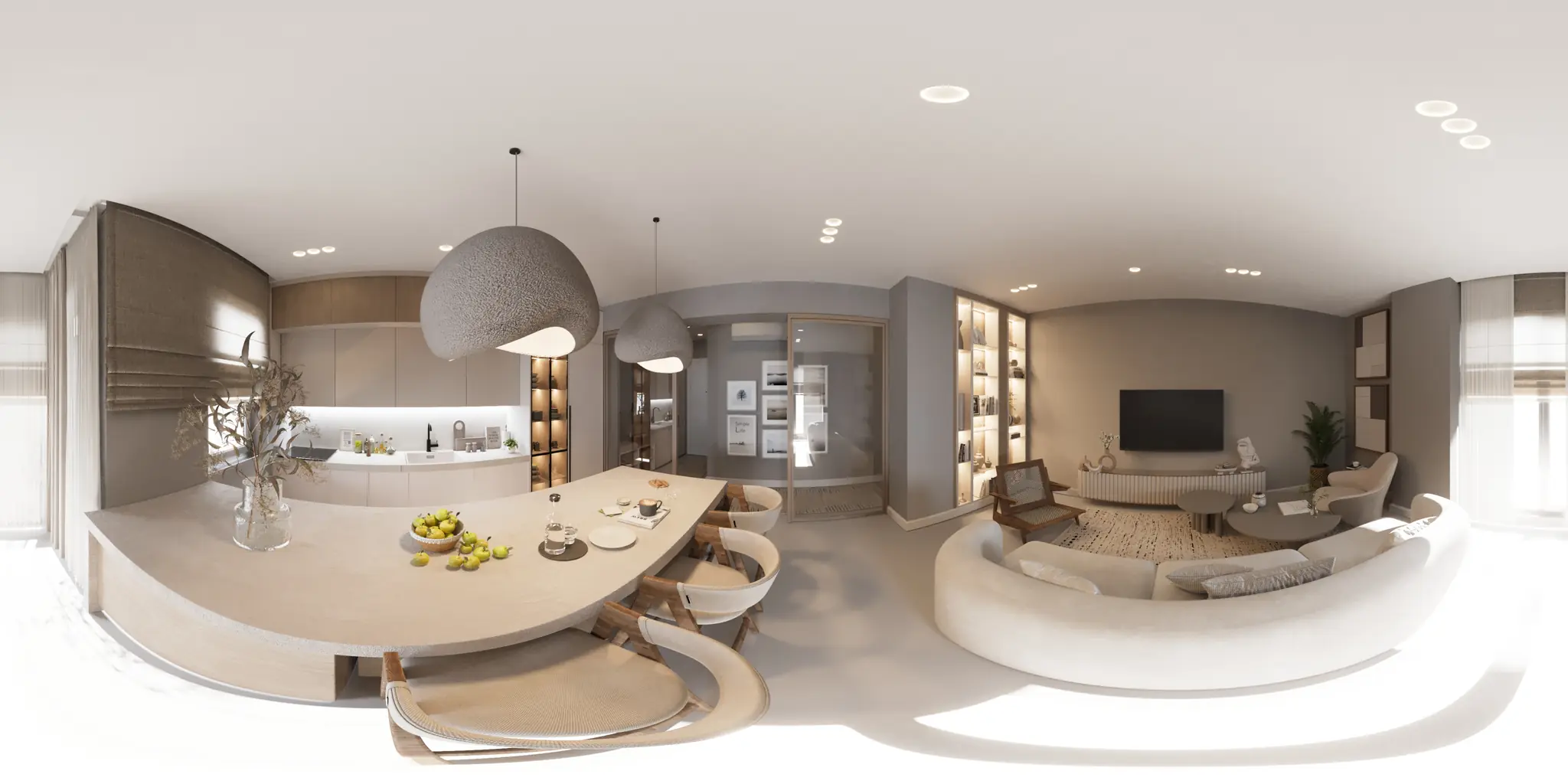
One 360 photo per room. 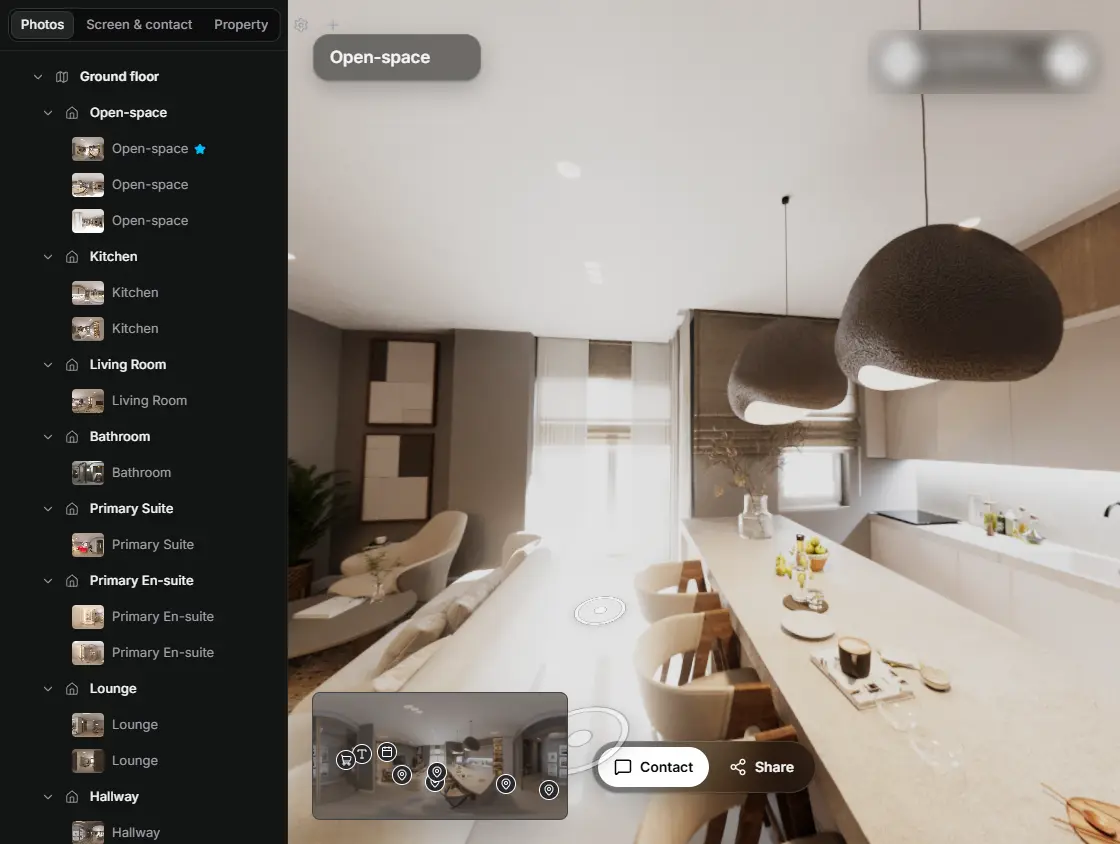
In the editor, drag a room onto its doorway and the two rooms are linked. 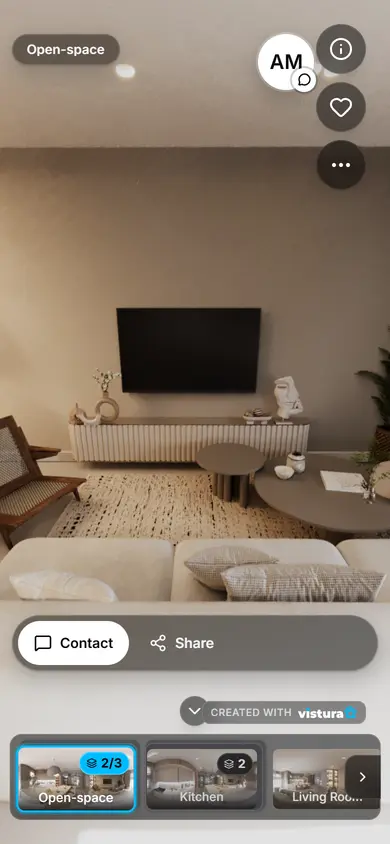
Buyers open the link on any phone, walk from room to room and can send you a question from inside the tour.
Free plan: 3 tours online at a time, with Vistura branding. Pro: unlimited tours online, with your own logo and colours.
How to see the sun exposure of a home
- Choose the place: type the city, or use your location if you are at the home. You can also paste coordinates (40.7128, -74.0060) or load a photo of the home taken with location on.
- Set the side you care about: the living room windows, the balcony, the backyard. Drag the blue handle round the rose, pick one of the eight directions, or stand at the window, tap "Use the phone's compass" and point the top of the phone straight out.
- Choose the day. Start with 21 December: it shows the least sun of the year in the northern hemisphere, and the sun's lowest arc.
- Move the time slider. The yellow sun moves along the day's path, and the line under the diagram says where it is and whether it shines on that side.
- Read the table: the hours of direct sun on that side on the solstices, the equinox and your day, and the times they start and end. Open "All eight sides" to compare the whole home.
What "south-facing" means for a home
A home, a room or a yard faces the direction you look in when you stand at its windows and look out. A south-facing backyard is behind a house whose back looks south. Listings use the same words: "south-facing living room", "southern exposure", "north-facing lot".
In the northern hemisphere, away from the tropics, the sun is due south at solar noon every day of the year. A south-facing side gets direct sun most of the day in winter, when the sun is low and its light reaches deep into the rooms. In summer the sun is high at midday and its light falls steeply, so less of it comes in through the windows.
East-facing rooms get the morning sun and lose it around midday; west-facing rooms get the afternoon and evening sun, which comes in low and long on summer evenings. North-facing rooms get little or no direct sun from fall to spring. In summer the sun rises and sets north of east and west, so a north side gets early morning and late evening sun at a grazing angle.
South of the equator it is the other way round: the sunny side is the north. In Sydney, Buenos Aires or São Paulo buyers look for north-facing homes.
Hours of direct sun by facing direction in New York
The tool's own figures for New York City, for a wall with an open horizon in front of it. Real homes get less where buildings, trees or a hill block the low sun.
| Facing | 21 June | 20 March | 21 December |
|---|---|---|---|
| North | 7.1 h (early and late) | 0.1 h | 0 h |
| North-east | 6.4 h | 3.8 h | 1.3 h |
| East | 7.5 h | 6.0 h | 4.6 h |
| South-east | 8.7 h | 8.3 h | 7.9 h |
| South | 8.0 h | 12.0 h | 9.2 h |
| South-west | 8.7 h | 8.3 h | 7.9 h |
| West | 7.5 h | 6.0 h | 4.6 h |
| North-west | 6.4 h | 3.9 h | 1.3 h |
| Daylight | 15.1 h | 12.1 h | 9.3 h |
For agents: the orientation in a listing
- Measure it at the home: stand at the main windows or the patio door, look out, and read the direction with a compass or this tool. Write the direction you measured, such as "living room and deck face south-west".
- Give hours of sun with their day: "about 8 hours of direct sun on the living room windows on 21 December". Say they are calculated for an open horizon; if the building across the street blocks the winter sun, say what the buyer will see.
- Show it in the tour: in a 360 tour, an information text on the window tells buyers when the sun comes in, in the room where they are looking.
- Shoot the 360 photos when the light shows the home as it is: a room photographed with sun on the floor tells buyers more than any sentence.
For buyers: check the sun at a viewing
- Open this page on your phone at the viewing, use your location, and set each side with the phone's compass at the window.
- Look at what stands in front of the windows: buildings across the street, trees, a hill. In winter the sun is low, so a building that looks far away can block it for hours.
- Check the rooms you use at the times you use them: the kitchen in the morning, the living room and the balcony in the late afternoon, the bedrooms at night.
- If you can, visit again at another time of day, or ask for photos taken in the morning and the afternoon.
How the sun is calculated
The sun's position comes from the equations NOAA's solar calculator uses, after Jean Meeus's Astronomical Algorithms: about one minute for sunrise and sunset and a fraction of a degree for the sun's direction. Times are shown in the place's time zone, with daylight saving time, from your browser's own time zone data.
The hours of sun count the time the sun is above the horizon and in front of the wall. They are for a flat, open horizon: read them as what the side gets without buildings, trees or hills in the way. A phone compass points to magnetic north, and the tool places the sun by true north. In most of Europe the two are a few degrees apart, which barely changes the hours. In parts of the US they are 10° to 15° apart (about 15° in Seattle and in Maine), and more in parts of Canada: there, check the direction on a map, or add your local magnetic declination (NOAA's declination calculator gives it) to the compass reading.
Questions
How do I find out which way my house faces?
Stand at the front door or the main windows and look straight out. Open this page on your phone, tap "Use the phone's compass" and hold the phone flat with its top pointing out: the tool reads the direction. Without a phone compass, find the street on a map, note the direction the front looks, and turn the rose to it.
Which direction is best for a house?
It depends on how you live in it. In the northern hemisphere a south-facing living room gets the most sun in winter, east-facing bedrooms and kitchens get the morning sun, and a west-facing deck gets the evening sun. Compare the sides in the table for the days that matter to you.
Is my location sent anywhere?
No. The city list is part of the page, the sun is calculated in your browser, and your location, the coordinates you type and the photos you load stay on your device. The page uses no map or address lookup service.
Does it account for buildings and trees?
The hours are for an open horizon, the way an architect's sun path diagram is read: they say what the side gets when nothing stands in the way. Look at what is in front of the windows and subtract the hours the low sun is hidden; the 360 photo view helps you see where the sun's path crosses a building.
My 360 photo shows the sun's path in the wrong place. Why?
The photo needs to know where north is. Some cameras write the compass heading into the file; most phones do not. Set it once: look at a window whose direction you know and tap the button under the view, or drag the red N to north. If the sun is in the photo, set the date and time the photo was taken and drag the yellow sun onto it.
Your next listing, as a tour
One 360 photo per room, linked together, shared in one link.
Free plan: 3 tours online at a time, with Vistura branding. Pro: unlimited tours online, with your own logo and colours.