South facing house: what it means and how to list it
What a south facing house really gets, hour by hour and season by season, and how to say it in a listing: the check, honest wording and the right photos.
A south facing house is a home whose front looks south, which tells a buyer less than it seems: its back garden then looks north, the shadier side north of the equator. South gets the most sun over the year, but not on every day. What counts is which side, how many hours and on which day, and a good listing says those three things. The figures below are computed with the code of our sun tool, which runs NOAA's solar equations.
What a south facing house actually means
In the US, the MLS data standard settles the term. RESO's DirectionFaces field is "the compass direction that the main entrance to the building faces". It then adds "It may also be known as the building exposure", and that second line is where the confusion starts. Each MLS may label the field its own way, so check how yours does.
So a south facing house has a north facing back, and a south facing garden belongs to a north facing house. Same word, opposite home. Always say which side you mean.
To read a side, stand at the window and look straight out. That is the direction that side faces. South of the equator the sides swap and north is the sunny side over the year, though in the tropics the sun passes on the south side around the December solstice.
How much sun does a south facing home get?
These are the hours of direct sun on a wall with an open horizon, New York City, 2026, computed with the tool's code.
| Faces | 21 June | 20 March | 21 December |
|---|---|---|---|
| North | 7.1 h (before 9 am and after 5 pm) | 0.1 h | 0 h |
| East | 7.5 h | 6.0 h | 4.6 h |
| South | 8.0 h | 12.0 h | 9.2 h |
| West | 7.5 h | 6.1 h | 4.6 h |
| Daylight | 15.1 h | 12.1 h | 9.3 h |
For comparison, Sydney on 21 June, its winter: north 9.9 h, south 0 h.
Four things follow from that table.
South does not always win. A south facing home gets the most in winter and around the equinoxes, but in June it falls behind south-east and south-west, which get 8.7 h each. In June the New York sun rises north of east (bearing 57°) and sets north of west (302°), so it spends the start and end of the day behind a south wall.
Hours are not strength. The June sun on a north wall comes early and late, at a grazing angle. Quote any hours with their times.
The low sun reaches further in. At noon the New York sun stands 72.7° up on 21 June, 49.3° on 20 March and 25.9° on 21 December. Through a window whose top is 7 ft (2.1 m) up, with no overhang, it reaches about 2 ft (0.7 m) into the room in June, 6 ft (1.8 m) in March and 14 ft (4.3 m) in December. The US Department of Energy's passive solar guide describes the same thing: the sun's "low rays in winter" and "high rays in summer".
Latitude changes everything. In London on 21 December there are 7.8 hours of daylight, the south side gets all of them, and the noon sun is only 15.1° up. In Miami on 21 June the south side gets 3.5 h and the north side 10.2 h, with the noon sun 87.7° up. In the tropics the June noon sun passes north of overhead (Honolulu: 87.9° up, bearing north), because at that solstice the sun stands over the Tropic of Cancer.
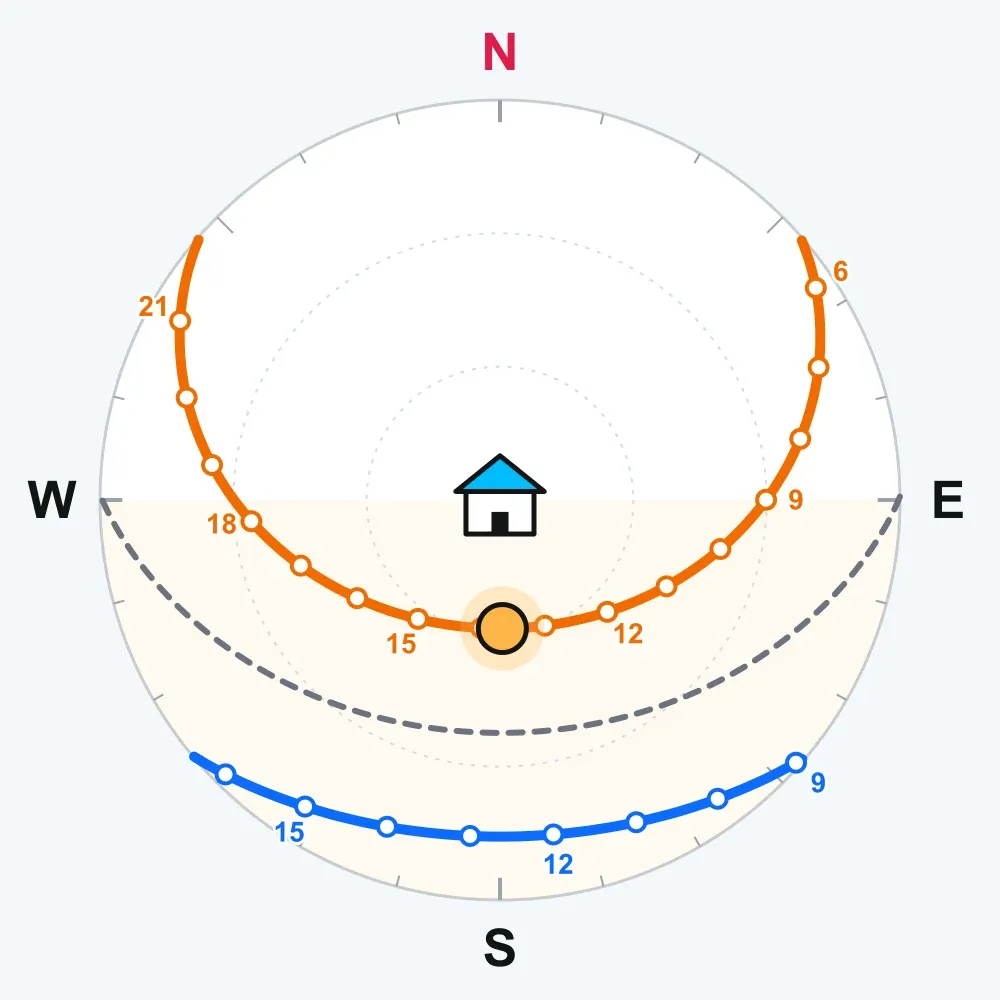
This diagram is drawn for Amsterdam, not New York, so do not read it against the table: New York's sun stands higher (72.7° at noon on 21 June, against about 61° in Amsterdam). You look down from above, with north at the top, and the centre is straight overhead. Orange is 21 June, blue is 21 December, the dashed grey arc is the equinox on 20 March. The numbers are local clock hours on a 24-hour clock, so 15 means 3 pm. The letters are the compass points: N, E, S and W.
Which direction should a house face?
No single direction is best: it depends on the climate and on the rooms people use. The Department of Energy's guide, design advice from 2010 and not a rule, says windows "should face within 30 degrees of true south, and during winter months they should not be shaded from 9 a.m. to 3 p.m." For warmer climates it says "use north-facing windows along with generously shaded south-facing windows".
As a guide to what each side gives:
- East: morning sun, which reaches kitchens and bedrooms on that side first.
- South: the longest stretch of sun from autumn to spring.
- West: afternoon and evening sun on the deck.
- North facing house: on that wall, little or no direct sun from the September equinox to the March one. Its back gets the rest.
Does orientation change the price?
Two real studies suggest it can. In Wellington, New Zealand, each extra daily hour of sunlight, averaged over the year, is associated with a 2.6% higher sale price, on over 5,000 sales. In Shanghai, across more than 40,000 apartments from 2019 to 2021, buyers paid about 7.2% more for south-facing units than for north-facing ones with no direct sun.
That is one city each, not a rule for your market. Use them in a talk with the seller and keep them out of the listing. The Wellington study measured hours with hills and buildings counted, and its authors note one house with 6.9 h a day and another, ten houses along the same street, with 9.9 h. That is why the check below matters more than the label.
The check before you write anything
This takes a few minutes per home, and it gives you the answer when a buyer asks.
- Name the sides that matter. Main living room, kitchen, main bedroom, garden or deck, balcony. Not only the front door.
- Read each direction at the window, looking straight out. A phone compass reads magnetic north, which NOAA says can be off true north by as much as about 20° in the US, so check on a map.
- Get the hours. Open Vistura's free sun path calculator, no account needed, set the place and the side, and read the hours and times for 21 June, the equinox, 21 December and today. The "All eight sides" table compares the whole home.
- Look at what stands in the way. The tool's hours are for an open horizon, "without buildings, trees or hills in the way", so this step is yours. Use the noon height as a test. In New York on 21 December the sun is 26° up, so anything to the south rising above the window by more than half its distance hides it even at noon. In London (15°) a quarter of the distance is enough. The rest of the day the sun is lower still. Add balconies above and deep eaves, which cut the high summer sun.
- Ask the seller when the sun reaches each room in winter. If you can, see one room at the hour you will quote.
- Keep the note: direction, day, hours, what blocks it.
What to say in the listing
"South facing" alone rarely tells a buyer what they want to know. Replace the label and the adjectives with what the check supports.
| Instead of | Write |
|---|---|
| South facing | Front door faces south. Living room and deck at the back face north. |
| Sunny all day | Living room faces south: direct sun from about 7:20 am to 4:30 pm on 21 December (calculated, open horizon). |
| Sun-drenched | Living room windows face south-west: about 8 hours of direct sun on 21 December and about 9 on 21 June (calculated, open horizon). |
| Great evening sun | Deck faces west: sun from about 1 pm to 8:30 pm in June (calculated, open horizon). |
| Bright (north side) | Studio faces north: no direct sun on these windows from autumn to spring. |
| Sunny flat (with a block opposite) | Faces south. The building opposite hides the low winter sun until about 11 am (seen on 12 December). |
These are examples. The times are New York's, and the 11 am and 12 December in the last row are invented to show the form. Yours come from the tool and from your visit.
The rules behind that table:
- Say the side, the hours and the day. Say "calculated" when calculated, and "seen" only when you were there.
- Do not claim savings on bills. Nothing about the label proves them.
- Do not hide a north side behind "bright". Say it faces north and sell the view or the space.
- Fill the MLS field as defined. Where your MLS has a direction field, the RESO definition is the entrance. Fill it that way and put the sun in the remarks.
- Have a short version for tight limits: "Living room and deck face SW: afternoon sun all year."
- Describe the home, not who it suits. Our listing description guide covers the fair housing part.
- Stay within the advertising rules. In the US, members of the National Association of Realtors must "present a true picture" in their advertising (Article 12 of its Code of Ethics). Your local advertising rules also apply.
How to show it
Photos at the right hour
Use the tool's times for the day of the shoot to plan your route: east rooms in the morning, west rooms after lunch, south around midday. Our real estate photography tips say to shoot interiors in soft light, and that stays the rule for the main photo of each room.
Add one proof shot where sun is the point: back to the window, sun on the floor. In the caption, give the side and the hour ("Living room, south-west, 3 pm in November"). Do not edit sun into a room.
A 360 photo with the sun path
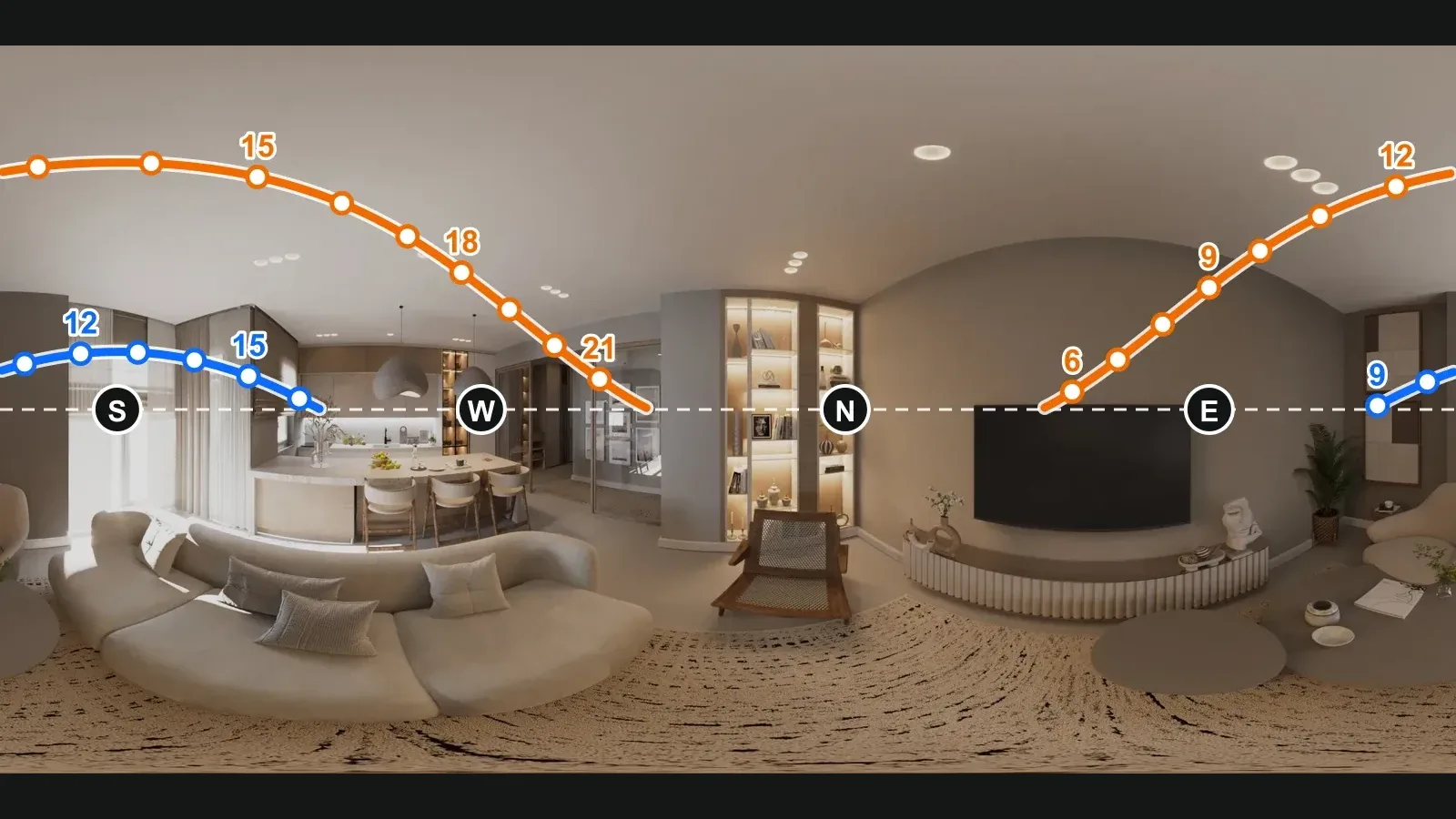
Load a 360 photo of the room into the same calculator, or choose "Try a sample room". The day's sun path is drawn over it with the hours, so you see through which window the sun comes in at 3 pm in December. North comes from the photo's compass heading when it has one, or you set it in a few seconds. The photo stays on your device. It works well at a valuation meeting, for a buyer's question, or as a screenshot for your file.
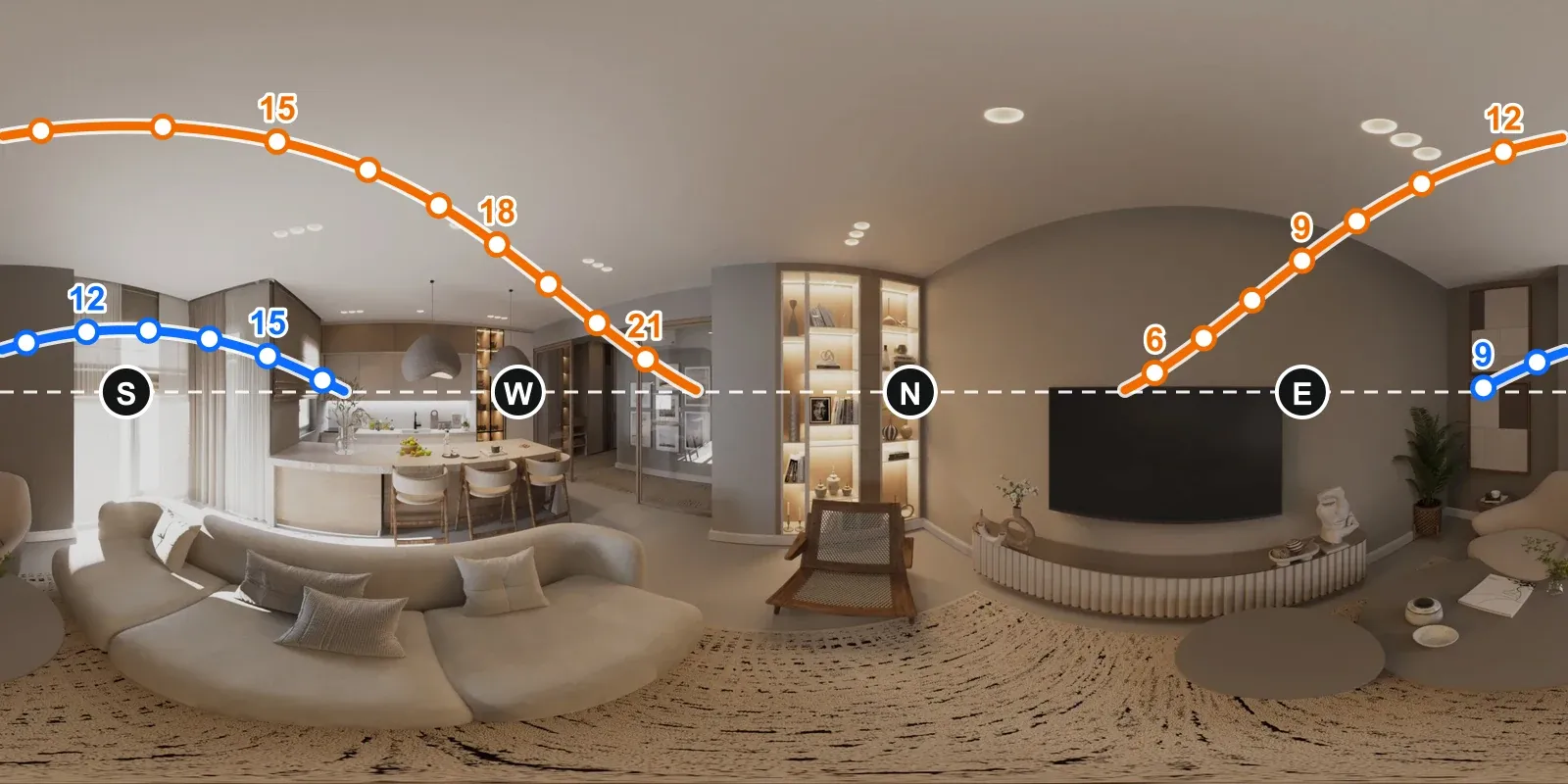
This is a sample room, placed in Amsterdam and unrolled flat so the whole 360 view fits. Orange is 21 June, blue is 21 December, and the numbers are local clock hours on a 24-hour clock. The letters on the dashed horizon are the compass points. In June the sun is already up at 6, towards the north-east, and still up at 21, towards the north-west. In December it stays low, around south.
A tour, where the buyer stands in the room
In a Vistura tour each room is a 360 photo, so the buyer checks the windows for themselves. Put a point on the window with its "Information text": "Faces south-west. Direct sun about 8 hours on 21 December and 9 on 21 June (calculated). Afternoon sun on this floor." A "Before / after" point shows the same view in the morning and the afternoon. Shoot the 360 photos when the light shows the home as it is. On Pro and Business, narration lets you say it in your own voice in every room, and the floor plan marks the current room, so buyers see where they are in the home. Those plans also keep unlimited tours online, where Free has 3 tours online at a time. See the plans.
Before you publish
- Side named, not only the front door.
- Direction read at the window and checked on a map.
- Hours given with a day.
- What blocks the sun said.
- Photos taken at the hour you say.
Then put the buyer in the room: our guide to the real estate virtual tour shows how a Vistura tour fits the listing, and the sun path calculator gives you the hours for the next home.
Frequently asked questions
Does a south facing house mean the garden faces south?
No. The label names the front, so the back and the garden of a south facing house look north. A south facing garden belongs to a north facing house. Ask, or check on a map, which side the seller means.
Does a north facing house get any sun?
Yes. Its back gets what any south facing side gets, and its north wall gets sun early and late in summer. In New York that wall gets 7.1 hours on 21 June and none on 21 December, computed for an open horizon.
Can I state hours of sun in a listing?
Yes, if you name the side and the day, say the hours are calculated for an open horizon, and have looked at what blocks the sun at that home.
Is it different in Australia or South Africa?
Yes. In both, north is the sunny side over the year, though in Australia's tropics the sun passes on the south side around the December solstice. In Sydney on 21 June, its winter, a north wall gets 9.9 hours of direct sun and a south wall gets none.