Twilight real estate photography: when, how, disclosure
Twilight real estate photography: how to find the blue hour for your address, prepare the lights, shoot and blend, do 360s at dusk and label edits.
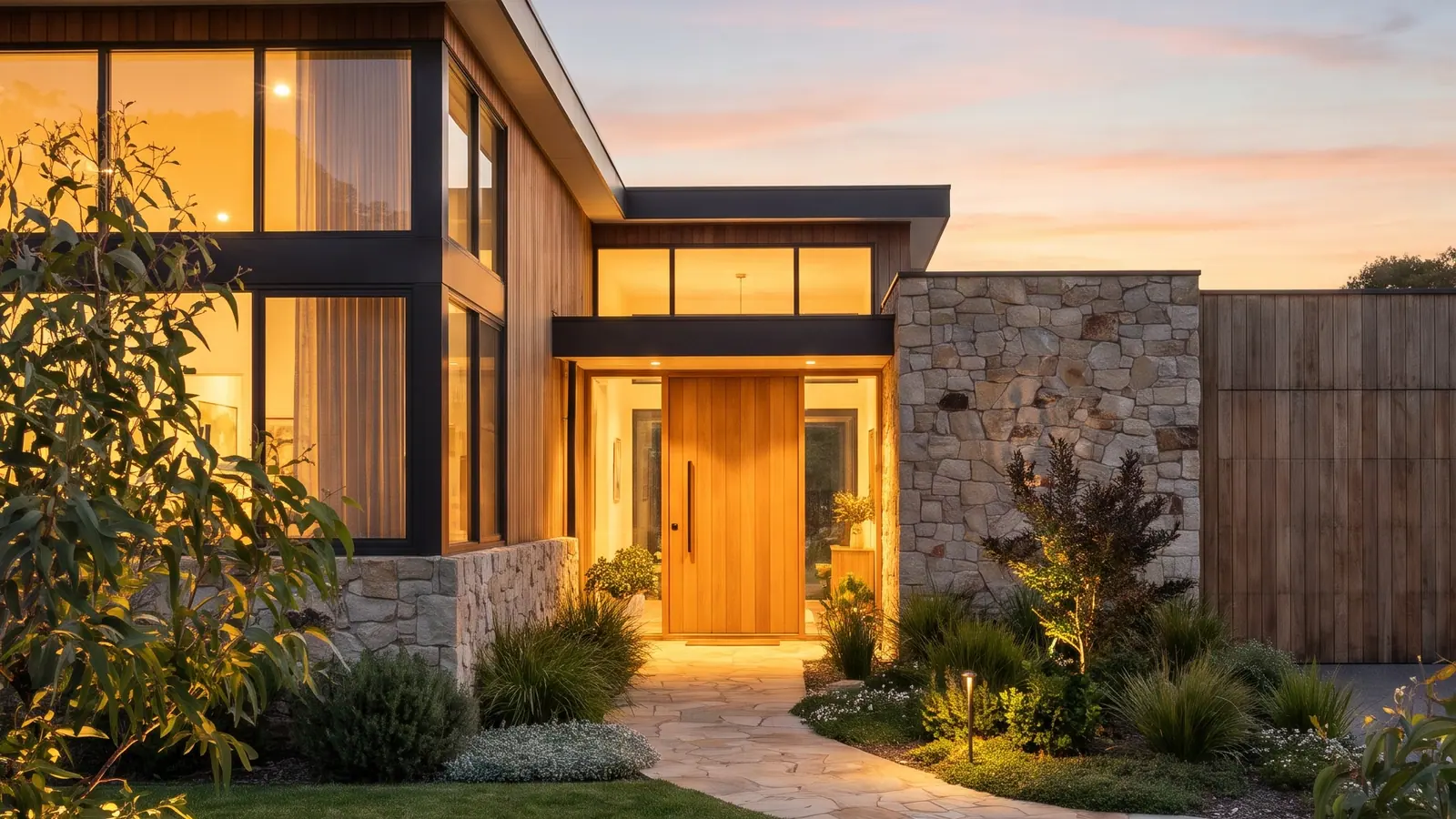
Twilight real estate photography means photographing a home in the few minutes after sunset, when the sky turns deep blue and every light in the house is on. It suits homes with lit windows, exterior lights, a pool or a view. It takes one visit timed to the minute, or a labelled edit of a daytime photo.
What twilight photos are, and which homes they help
A twilight photo is taken in the blue hour after sunset (or before sunrise) with the house lit from inside. The warm windows against a blue sky are the whole effect: the home looks lived in, and the eye goes straight to it.
Homes that gain the most:
- exterior lighting on the paths, the facade or the garden;
- big windows on the front;
- a pool, a pond or water nearby;
- outdoor living: a terrace, a fire pit, an outdoor kitchen;
- a view of a city, the coast or the hills;
- a front that looks flat in daylight.
Skip it when:
- the front has few windows, or there are no exterior lights;
- the home sits inside a block where you cannot step back far enough;
- a busy road runs in front, so headlights cross every long exposure;
- the listing has to go live tomorrow and the weather or the timing will not cooperate.
One hero shot is usually the job. Common practice is one twilight hero plus a couple of secondary dusk frames, such as the back garden or the pool. The rest of the listing stays daytime: for that part, see shooting the rest of the listing.
When to shoot: blue hour, civil twilight and the minutes for your address
Two terms matter. During civil twilight, the centre of the sun is at most 6 degrees below the horizon (timeanddate, civil twilight). It is the brightest of the three twilight phases. The blue hour is when blue light dominates, most likely with the sun between 4 and 8 degrees below the horizon (timeanddate, blue hour). So the blue hour starts during civil twilight and ends after it, in nautical twilight.
The blue hour is shorter than its name. The same timeanddate page gives about 16 minutes near the equator (Quito), about 20 minutes around 40 degrees latitude in March (New York) and about 30 minutes around 60 degrees (Oslo). Its length changes with the season too.
To find the minutes for one address:
- Get the sunset time for the address on the shoot date.
- Open timeanddate's Sun Calculator for the city and read the solar elevation graph for the stretch when the sun is 4 to 8 degrees below the horizon.
- Build your timeline backwards from sunset.
For step 1, the free sun path calculator gives sunrise, sunset and solar noon for your city or typed coordinates and any day, in the place's own time zone, and shows the hours of direct sun on the side of the house you pick.
Which way the front faces decides where the colour is. The sun sets in the west, so a front that faces west gets the last light on its face, with the colourful part of the sky behind the camera. A front that faces east has the sunset colour in the sky behind the house, which often makes the better hero frame. Check the facing before you pick the angle.
An example plan (a starting point, not a measured schedule):
| When | What |
|---|---|
| 60 minutes before sunset | Arrive, set up the tripod, pick the angle |
| 15 minutes before sunset | Every light on, curtains set, cars gone |
| Sunset | First frames: a base for the house and the ground |
| Blue hour | The hero frames, with sky and windows balanced |
| Sun 8 degrees below the horizon (end of the blue hour) | A last safety frame; after it the sky turns dark fast |
The hour of set-up follows the advice to arrive "at least one hour before sunset" from Expert Photography.
Get the house ready
The window is short, so the house has to be ready before you are. A real estate photographer writing for NAR in 2016 listed what sellers can do (NAR, 2016):
- Someone who knows every interior, exterior, landscape and pool light should be there. They arrive early to switch everything on and stay ready to turn off harsh floodlights the photographer does not want.
- Stop watering at least two hours before, so paths and patios are dry.
- Clean the pool.
- Light the outdoor fireplace.
- Take the covers off outdoor furniture and the grill.
- Put the cars in the garage or on the street away from the front.
- Sweep the paths.
Add a few points from common practice:
- Replace every dead bulb, inside and out. A dark window in a row of lit ones is the first thing a buyer sees.
- Use bulbs of one colour in the rooms that face the camera. Mixed warm and cool bulbs show as patches of yellow and blue; real estate photo editing explains how to handle mixed light.
- Set blinds half open, so the windows glow without showing clutter.
- Put away toys, hoses and bins.
Gear and settings
The kit is short: a tripod (exposures run long, and every frame has to line up for blending), a remote release or the self-timer, and the lens you use by day, so the dusk frame matches the rest of the set.
Settings are a starting point, not a recipe: manual exposure, so the camera does not chase the changing light; a low ISO; a mid aperture; RAW if the camera has it; and the same white balance for every frame, so the frames blend.
The shutter speed lengthens as the light drops, so check the exposure every few minutes rather than setting it once.
A phone on a tripod with its night mode works for a social post. It gives you one processed frame, though, not a sequence you can blend later.
If you want an aerial at dusk, flying a drone at dusk has its own lighting rule to follow.
The shoot: one sequence, then blend
Frame the shot, lock the tripod and do not move it until the sky is dark.
- Early frames, around sunset, hold the house and the ground: facade texture, lawn, paving.
- Middle frames balance the windows and the sky. This is often the hero on its own.
- Late frames give the deep blue sky and the strongest glow from the windows.
Bracket each moment: several exposures of the same frame, darker and lighter. How many brackets and how to merge them is covered in bracketing and merging step by step.
Then blend in layers with masks: the house from an early frame, the windows and the sky from a later one. Keep it believable. The sky over the house must be the sky you shot that evening, and the shadows stay dark. Expert Photography's last tip is "Do Not Overprocess", and it holds: a glowing lawn and a blue that never existed read as fake.
Twilight 360 photos
A 360 records the whole sky at once: the bright west and the dark east are in the same photo. That is why a 360 at dusk needs bracketing even more than a flat frame.
On the Insta360 X4, X4 Air, X5 and X6, AEB "captures multiple images at different exposure values in succession" and suits scenes where "the environment is relatively static" (Insta360 manual). On the X6 you find it in 360 Photo mode: swipe up, choose "HDR Photo", then "AEB", and set "Number of photos" and "Exposure Step". The X6 takes 3 or 5 shots at 120MP and 7 at 30MP. On other cameras, use their bracketing mode and check the manual.
How to shoot it:
- Use a tripod and the timer or the app trigger.
- Step out of sight. In a 360 there is no "behind the camera": go round a corner or inside.
- Two or three positions are enough: the front, the back garden or pool, perhaps a terrace. Inside, keep your daytime 360s.
- Balance inside and outside. Switch on the lamps in every room you see through the glass. If the interiors burn out to white, shoot earlier in the window, when the sky is still brighter.
New to the format? Start with what a 360 photo is.
Virtual twilight: the edit, and when to label it
Virtual twilight is a daytime exterior edited to look like dusk: a new sky, glowing windows, sometimes lit lamps. Editing services and AI tools sell it per photo; see what a dusk shoot or edit costs.
It is the right call when it rains on every possible shoot day, when the deadline will not wait, or when a vacant home has no working lights.
What the rules say:
- California, since 1 January 2026 (Business and Professions Code 10140.8). A licensee who uses a "digitally altered image" in advertising must include a statement "disclosing that the image has been altered", on or next to the image, with a link, URL or QR code to the original. Where the agent controls the website, the unaltered version or a link to it must be there too. Lighting, white balance, colour correction and similar edits are excluded only when they do not change how the property is represented. Changes to the landscape, the facade and what is visible from the property count as altered.
- San Diego MLS (SDMLS explainer). "Adjust lighting, brightness, or exposure" needs no disclosure, yet the page's own dusk example is labelled "Digitally Altered" with "Disclosure Required". In print, it says to "Add a QR code or link to view the original photo online".
- CRMLS (Digitally Altered Images FAQs, updated 13 February 2026). Altered photos carry a label such as "Photo Modified" or "Digitally Altered", with the original "immediately before or after". Elements outside or visible from the property may not be changed. The FAQ does not mention twilight or skies.
The law does not say in so many words whether a day-to-dusk edit is altered. The safe practice is to treat it as altered: label it and put the original next to it. Ask your MLS if you are unsure. Never add a sky the house never had (no mountains, no sea), and no lights that are not there. For every other edit, see the full table of what MLSs let you edit.
Outside the US, check the portal's rules and the consumer-protection rules where you list before you publish an edited dusk photo.
Use the dusk shot in the listing and the tour
The dusk frame works hardest where people see it first. In a Vistura tour, set it as the "Cover image", which people see before they open the tour (without one, the first photo is used). For a 360 of the front taken at dusk, make it the "First photo" and use "What buyers see first" to turn it to the lit house. Regular photos and 360 photos sit in the same tour, so a flat dusk hero and daytime 360 rooms go together. One tip: "Auto colour" in the editor, and the free brighten tool, take out the yellow or blue cast of indoor light, which is exactly the contrast a dusk shot wants. Use it on the daytime rooms and leave the dusk shot as you blended it.
Then put the shot to work beyond the listing. "Images for social media" turns the tour into posts with the photo, the property details and a QR code, on every plan; on Pro you pick the design and your logo shows. Every new account gets 14 days of Pro with no card; see pricing.
Checklist
- Date chosen, back-up date set, sunset time noted.
- Blue hour read for the address, and the facing of the front checked.
- Every light tested, dead bulbs replaced, bulb colours matched.
- Watering stopped, pool clean, covers off, cars and hoses gone.
- Tripod, remote, spare batteries, cards.
- Same frame shot from sunset to the end of the blue hour, bracketed.
- 360 positions bracketed, with you out of sight.
- Edit labelled and original kept next to it, where the rules ask.
Frequently asked questions
What time should twilight real estate photos be taken?
Start at sunset and keep shooting until the sun is about 8 degrees below the horizon, a little after civil twilight ends; the best frames usually come when the sun is 4 to 8 degrees below. Dawn works too, in the same window before sunrise and in reverse order: the sky starts dark and gets brighter, roads are quieter, and the lights have to be on before you arrive. It suits a home whose front faces east.
How long does the blue hour last?
Less than its name suggests: about 16 minutes near the equator, about 20 minutes around 40 degrees latitude in March and about 30 minutes around 60 degrees, and it changes with the season. On a cloudy evening the colour can be weak or grey, so keep a back-up date in the diary rather than relying on an edit to rescue it.
Do I have to disclose a virtual twilight photo?
Treat it as altered: label it and keep the original next to it, and ask your MLS if you are unsure. In California, an MLS help page marks its own dusk example as needing disclosure. In print, a label means a line such as "Image has been digitally altered" on the flyer or brochure, plus a QR code or link that opens the original photo online.
Can you take twilight photos with a 360 camera?
Yes, from a tripod, with the camera's exposure bracketing switched on and you out of sight. A 360 sees the bright west and the dark east in one frame, so bracketing matters more than it does for a flat photo. Plan two or three outdoor positions and keep the indoor 360s from your daytime shoot.