Best camera for real estate photography: 6 picks and lenses
Six cameras for real estate photography by budget, with sensor, brackets and weight from the makers' pages, the wide lens to pair, and when a phone will do.

The best camera for real estate photography is not the one with the most megapixels: it is a body that brackets exposures for rooms with bright windows, takes a wide lens, and sits still on a tripod. Below you get six bodies grouped by budget, the lenses to pair with them, and the cases where a phone or a 360 camera does the job instead.
Every figure in the tables comes from the maker's own page, read in November 2026, and is linked. Makers replace models often, so check the newest version in the maker's store before you buy.
What matters in a camera for rooms
Rooms are a hard subject in one way only: a bright window next to a dark corner. Everything else is about a wide view and keeping the camera still.
- Sensor size. Full frame is about 36 x 24 mm (Nikon gives 35.9 x 23.9 mm); APS-C is smaller and varies a little by maker: Nikon's DX is 23.5 x 15.7 mm. The bigger sensor keeps cleaner shadows at the same exposure and has more very wide lenses. APS-C costs and weighs less.
- Bracketing (AEB). How many shots the camera takes in one press, and how far apart. Our HDR real estate photography guide explains how many you need.
- The lens mount and the wide lenses made for it. The lens matters more than the body, so check the wide zooms before you choose the camera.
- A tripod socket and a remote or app release. The brackets only line up if nothing touches the camera.
- Resolution is the least important line. Listing sites and tours show photos far smaller than any sensor here.
- Files. Shoot RAW so you can edit, then export JPG for the listing and the tour.

The best cameras for real estate photography by budget
The six bodies below cover a first camera, a full-time full-frame kit and a high-resolution option. Prices change by country and by week, so check the maker's store on the day.
| Camera | Sensor | Resolution | Bracketing and HDR (maker's words) | Weight with battery and card | Suits |
|---|---|---|---|---|---|
| Canon EOS R50 | APS-C | 24.2 MP | AEB ±3 stops in 1/3-stop steps | 375 g | First camera, agents shooting their own listings |
| Nikon Z50 II | DX, 23.5 x 15.7 mm | 20.9 MP | Exposure bracketing; HDR overlay | about 550 g | First camera on Nikon's system |
| Canon EOS R8 | Full frame | 24.2 MP | AEB ±3 stops in 1/3 or 1/2 steps; HDR mode merges 3 shots | 461 g | Lightest full frame here, a step up from APS-C |
| Canon EOS R6 Mark II | Full frame | 24.2 MP | AEB ±3 stops in 1/3 or 1/2 steps; HDR mode takes 3 shots | 670 g | Full-time photographer on Canon |
| Nikon Z6 III | Full frame, 35.9 x 23.9 mm | 24.5 MP | 3, 5, 7 or 9 shots; up to 5 shots at 2 EV or more; HDR overlay | about 760 g | Full-time photographer who brackets wide |
| Nikon Z7 II | Full frame, 35.9 x 23.9 mm | 45.7 MP | Exposure bracketing | about 705 g | Large homes, crops for print and brochures |
Canon's spec pages give the bracketing range (±3 stops) but not the number of shots, so check the camera's manual for how many frames one press takes. Sony's full-frame bodies are a common choice too; compare them on the same lines.
A first camera: Canon EOS R50 or Nikon Z50 II
Both are APS-C bodies light enough to carry to five viewings in a day. The R50 is the lighter of the two at 375 g. The Z50 II has an HDR overlay mode as well as bracketing, so it can merge in the camera when you are short of editing time. Either one is a clear step up from a phone once you pair it with a wide APS-C zoom.
Full frame for weekly shoots: Canon EOS R8, R6 Mark II or Nikon Z6 III
The R8 is the lightest full-frame body in this list at 461 g. Canon announced the EOS R8 Mark II in September 2026, with in-body image stabilisation at about 546 g; compare the two in Canon's store before you buy. The R6 Mark II is heavier and built for daily work. The Z6 III bracketing page lists programmes of 3, 5, 7 or 9 shots in steps from 0.3 to 3 EV; at 2 EV or more it takes up to 5 shots. That is enough for a room with the sun in the window.
High resolution: Nikon Z7 II
At 45.7 MP, the Z7 II gives you room to crop a wide frame into two photos or print a large brochure. For listing photos alone it is more than you need. It is an older model, so check whether a newer one has replaced it.
Best lens for real estate photography
The best lens for real estate photography is a wide rectilinear zoom that reaches about 14 to 16 mm in full-frame terms. Most rooms need something between 14 and 24 mm on full frame.
Focal length in degrees
Millimetres are hard to picture, so here is the horizontal angle each focal length sees on a full-frame body. We computed them from the sensor width (2 x atan(36 / (2 x focal length))) and they match Canon's own figures at 14 mm and 35 mm:
| Focal length (full frame) | Horizontal angle |
|---|---|
| 14 mm | about 104° |
| 16 mm | about 97° |
| 20 mm | about 84° |
| 24 mm | about 74° |
| 35 mm | about 54° |

APS-C without the arithmetic
A smaller sensor shows less of the room through the same lens. Makers' figures make the point. The Nikon Z 14-30mm f/4 S sees 114° diagonally on a full-frame body but only 90° on a DX body. Canon's RF-S10-18mm at 10 mm sees 97°10' across on APS-C, about the same as a 16 mm on full frame.
So an APS-C buyer needs a wide zoom made for APS-C, not a full-frame 14 mm.
Rectilinear, not fisheye
A rectilinear lens keeps straight walls straight. A fisheye bends them into curves. Fisheyes belong to 360 capture, where software stitches the curve away, not to listing photos.
Do not go wider than the room needs either. Furniture at the edge of a very wide frame stretches, and the room looks bigger than it is. The real estate photography tips give the same advice for phone lenses.
Four wide lenses from the makers' pages
| Lens | For | Angle of view (maker's figure) | Weight | Note |
|---|---|---|---|---|
| Canon RF-S10-18mm f/4.5-6.3 IS STM | Canon APS-C (R50) | 97°10' to 64°30' horizontal | 150 g | A light way to go wide on APS-C |
| Canon RF14-35mm f/4L IS USM | Canon full frame | 104° to 54° horizontal; 114° to 63° diagonal | 540 g | Image stabilisation; 77 mm filters |
| Nikon NIKKOR Z 14-30mm f/4 S | Nikon full frame (narrower on DX) | 114° to 72° diagonal on FX; 90° to 50° on DX | about 485 g | Takes 82 mm screw-in filters |
| Canon TS-E 17mm f/4L | Made for Canon's EF mount | 93° horizontal, 104° diagonal | 820 g | Tilt-shift lens, manual focus |
Tilt-shift lens or software correction?
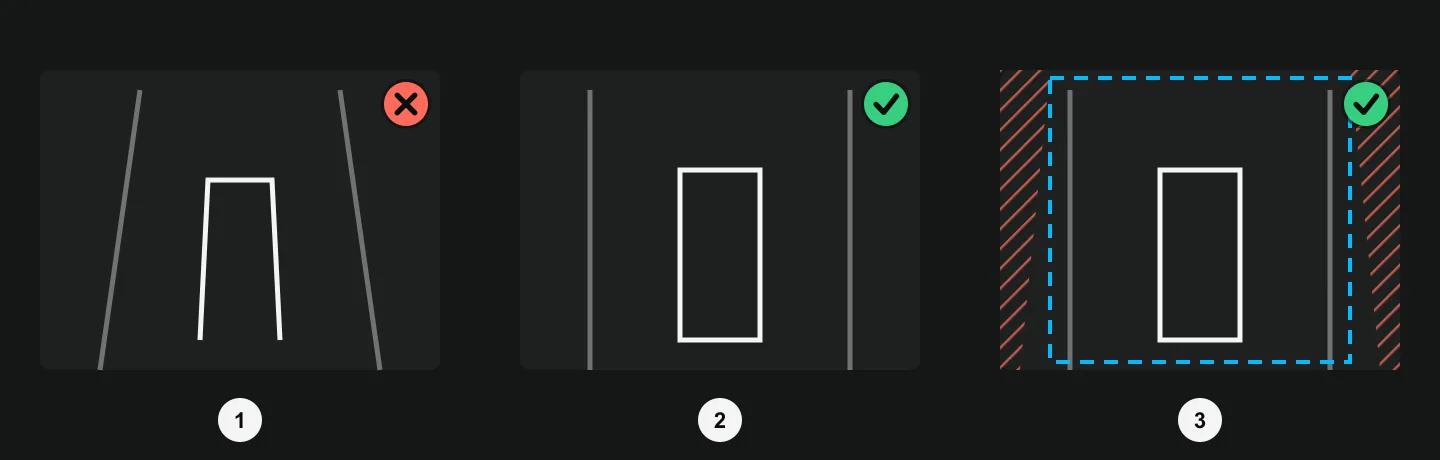
Point a camera up to fit the ceiling and the walls lean towards each other. A shift lens fixes this at the shot: the camera stays level and the lens slides up, so the walls stay vertical and you keep every pixel. The price is weight (820 g for the TS-E 17mm above), manual focus and the lens's own cost, so compare it with the body's in the maker's store.
Software does the same job after the shot. It straightens the lines and crops a little from the edges, so frame slightly wider than you need. Our free Fix vertical lines tool straightens leaning walls and door frames in a room photo, automatically or with sliders, crops the empty corners and downloads with no watermark. The photo never leaves your device, and you do not need an account.
A phone or a 360 camera instead
The phone. For a first listing, yes, a recent phone on a small tripod does the job. The real estate photography tips cover the settings and which lens button to use. A camera adds three things:
- bracketing you control, with the number of shots and the gap between them;
- a real wide zoom instead of a fixed ultra-wide;
- RAW files from a bigger sensor, with more room to lift shadows.
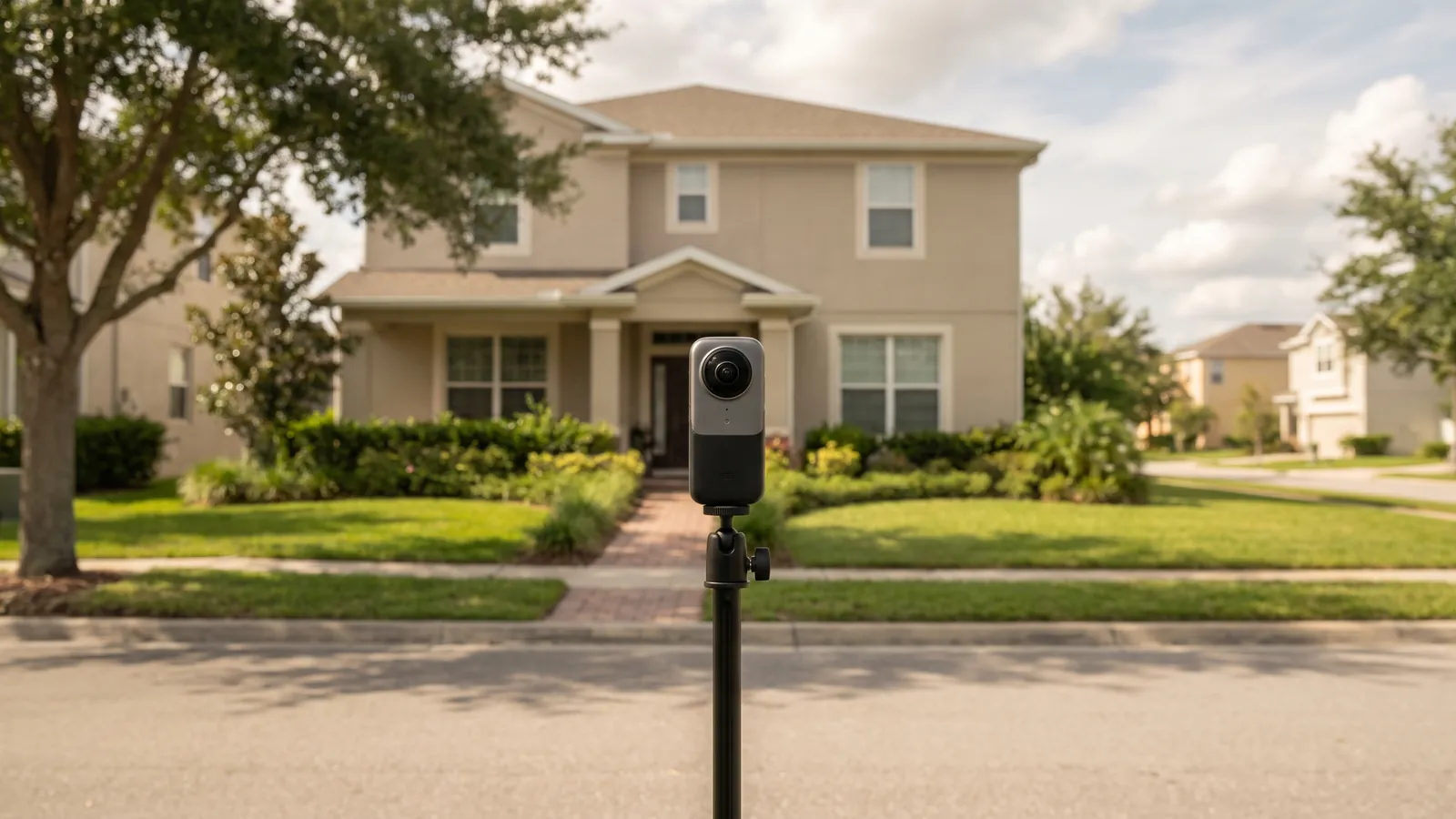
The 360 camera. This is a second camera with a different job: it makes a tour buyers walk through, not the listing's lead photo. Our guide to the 360 camera for real estate compares the models.
No 360 camera yet? Vistura Capture takes 360 photos with the phone you already have. Free to capture, nothing to install.
From the camera to the listing and the tour
Once the shoot is done, the path to the listing is short:
- Edit the RAW files. Exposure, white balance, verticals. The real estate photo editing guide covers the order.
- Export as JPG. Buyers see the finished photo, not the RAW file.
- Hide private details. Faces in family photos, number plates in the drive, letters on the worktop.
- Upload. To the listing, and to the tour if the home has one.
A Vistura tour takes the photos straight from your camera. Ordinary photos are shown flat, as taken, and visitors go from photo to photo; 360 photos let visitors look all around the room, and both can sit in the same tour. Upload JPG, PNG or WebP up to 25 MB each. The same jobs are built in: "Straighten" in each photo's menu fixes leaning walls in ordinary and 360 photos, "Auto colour" brightens dark rooms and keeps the windows, and "Blur parts of the photo" hides faces, plates and documents, on every plan, with the original kept. Before upload, the free brighten tool and blur tool do the same on your device. On Pro you fine-tune the colour by hand and the tour carries your logo and colours. Every account starts with 14 days of Pro, no card needed; then compare the plans.
Which one to buy
Every pick below comes from the tables above:
- First camera, tight budget: an APS-C body (Canon EOS R50 or Nikon Z50 II) with an APS-C wide zoom, such as the RF-S10-18mm on Canon.
- Shooting every week, rooms with big windows: a full-frame body with deep bracketing (Nikon Z6 III) or the lightest full frame (Canon EOS R8), with a 14 mm zoom.
- Large homes and print: the 45.7 MP Nikon Z7 II.
- Straight walls without editing time: a shift lens. Otherwise, correct in software.
If you are turning this kit into a business, see how to become a real estate photographer and how to build a real estate photography portfolio that wins agents.
Frequently asked questions
Do you need a full-frame camera for real estate photography?
No. An APS-C body with a wide APS-C zoom covers most homes and costs and weighs less. Full frame pays off when you shoot every week, often into bright windows, and want cleaner shadows.
What focal length is best for real estate photos?
Between 14 and 24 mm in full-frame terms for most rooms. On an APS-C body, look for a zoom that starts around 10 mm, which sees about as much of the room as a 16 mm on full frame.
Is a fisheye lens good for real estate photography?
Not for listing photos. A fisheye bends straight walls and door frames into curves, which buyers notice. Use a rectilinear wide lens; fisheyes belong on 360 cameras, where the curve is stitched away.
Can I put RAW photos in a virtual tour?
Export them as JPG first. Tours take JPG, PNG or WebP, so edit the RAW file, then export the finished photo.