Real estate slogans: examples, a sign test and the rules
Real estate slogans by agency type, from luxury to rentals, how to test one on a sign, a card and a listing, and the fair housing and FTC rules on claims.
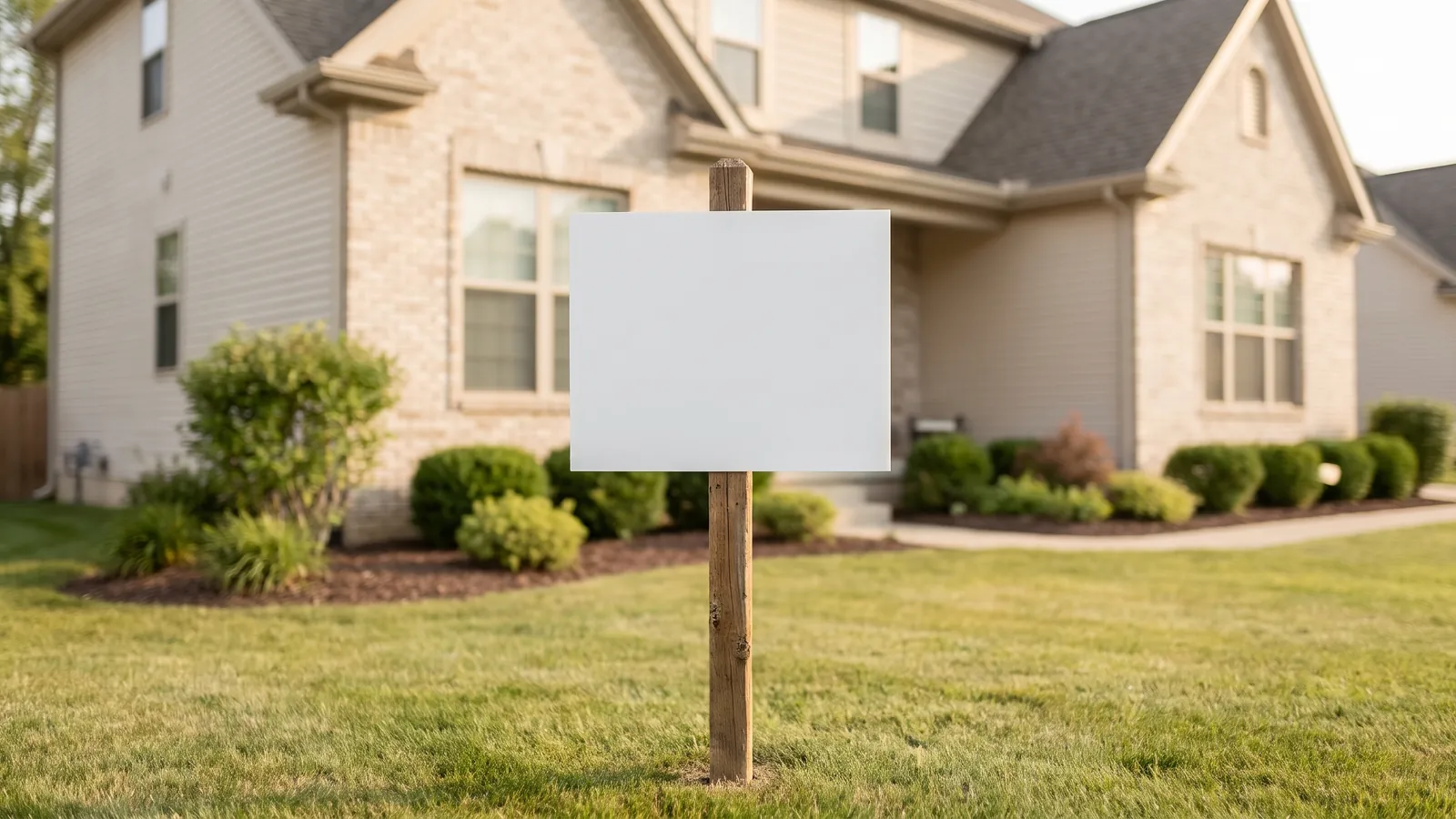
Real estate slogans work when they are short, true and readable from across the street. Below you will find examples sorted by type of agency, a three-step test for the sign, the card and the listing, and the claims the rules forbid. Every slogan here was written for this article, so you can adapt it without borrowing someone else's line.
What a real estate slogan has to do
A slogan has one job: tell a stranger, in one line, who you help and where, or how you work. A buyer driving past your sign gives it a second or two. A seller looking at your card gives it a little more. In both cases the line has to say something they can remember.
Before you fall for a line, check three things:
- It fits one line on a sign. If it needs two, it is a sentence, not a slogan.
- It is true, and you can show it. "Since 1998" is a fact you must be able to back up. "We love [town]" is an opinion.
- It is yours. A line that echoes a big brand or a rival agency invites trouble.
Lists online disagree on length: some say five words or fewer, others say up to eight. No study settles it, so skip the word count and use the sign test below instead. Keep the slogan next to your mark, not inside it: a logo has to work small, and a line of text inside it stops being readable long before the mark does. The real estate logo guide covers the mark itself.
Real estate slogans by type of agency
Every example below was written for this article. Replace the words in brackets with your own area, year or name.
| Agency type | Example slogans | What to watch |
|---|---|---|
| Luxury | "Fine homes in [area], shown privately." / "Homes in [area], presented in full." | "Exclusive" and "private" may describe the service or the home, never who may buy |
| Local or family office | "[Town] homes since [year]." / "Your neighbours on [street] since [year]." | The year is a fact, not an opinion: it must be true |
| New builds | "Plans, prices and handover dates, in one place." / "[Development]: see the plans before the walls." | Promise only what is built or approved, and say when a picture is a rendering |
| Rentals and lettings | "Rentals in [town], with the rules in writing." / "From viewing to keys, one team." | Never say who may apply or who is welcome ("ideal for professionals", "no kids") |
| Commercial | "Shops, offices and warehouses in [area]." / "Commercial space in [area], measured and mapped." | Numbers such as footfall or yields need a source, dated in the ad |
| Solo agent | "[Name]. One agent from listing to keys." / "[Name]: [town] homes, one phone number." | A promise such as "I answer every call" is a claim you have to keep |
A few patterns hold across the table. The strongest lines name a place, because a place is the one thing a rival across town cannot claim. The next strongest describe how you work in plain words ("one team", "in writing"). The weakest are adjectives with nothing behind them: "trusted", "premier", "dedicated". Every agency says them, so nobody remembers them.
By market. In the US, the REALTOR® mark belongs to the National Association of REALTORS® and only members may use it; the logo guide explains how. In the UK, write "sales and lettings" or "estate agents", and know that the ASA reads "leading" or "Number 1" as a claim about sales or market share (more on that below). Elsewhere, check what your national advertising regulator says about comparative and superlative claims before you print.
Test it on a sign, a card and a listing
A slogan that reads well on a screen can fail on a post at the end of a drive. Test it where it will live.
On the sign
The reading distance decides the letter size. Sign research by Garvey and Klena, published in the Interdisciplinary Journal of Signage and Wayfinding (2020), uses a legibility index of 1 inch of letter height per 10 feet of distance for signs parallel to the road, and 1 inch per 30 feet for signs facing the traffic. It was written for business signs read by drivers, so treat it as a rule of thumb for a for sale sign.
Here is the arithmetic for one case. To read a slogan from a car 60 feet away, the letters need about 2 inches if the sign stands at a right angle to the road, facing oncoming traffic, and about 6 inches if it runs parallel to the road. If letters of that size do not fit on one line of your panel, the slogan is too long. Shorten the slogan, not the letters.
The practical test takes ten minutes: print the panel at full size, tape it to a wall or a post, and walk to the kerb. If you squint, a driver will not read it.
With the QR code
A sign has two reading distances. The name, the phone number and the slogan are read from the car. The QR code is read from the pavement by someone who stopped. So do not shrink the code to make room for the slogan. A common rule of thumb is that the code should be at least a tenth of the distance it is scanned from: about 25 cm (10 in) wide for 2.5 m (8 ft). One short line under the code that says what it opens does more than a second slogan. The QR code guide for real estate signs covers placement and print sizes.
To try the pair before you order signs, use the free real estate QR code generator. Its "Window card (A5 or A4)" prints "a headline, the QR code at" a set size, "one line that says what scanning does, and your details". Type your slogan in "Headline" (up to 60 characters, on up to two lines), keep "Line under the code" as "Scan to walk through the home in 360", and print one. Inside the app, every tour already has its own "Tour QR code", "for shop windows, flyers and for-sale boards", and that code never changes.
On the card
Hold the printed proof at arm's length. If the slogan pushes your phone number, your licence details or another required line into smaller type, cut it or move it to the back. The business card guide covers what the card must carry.
On the listing
Your slogan belongs in your profile and your ads, not across the listing photos. Before you put any text on a listing photo, read your MLS's or portal's media rules. In the description itself, facts about the home beat any slogan; the listing description guide shows how to write them.
What the rules forbid in a slogan
This is not legal advice. The rules below were read on 12 November 2026; check your state, your broker and your MLS too. A slogan repeats on every sign, card and ad, so a bad word in it repeats everywhere.
Think of claims as a ladder. The higher you climb, the more proof you need.
| Kind of claim | Example | What it needs |
|---|---|---|
| Opinion | "We love [town]." | Little: the reader can judge it |
| A checkable fact | "Since [year]." / "[number] homes sold in [year]." | Evidence, kept, before the ad runs |
| A comparison | "#1 in [town]." / "Fastest sales in [area]." | Data that proves it, with period and area |
| Who the home is for | "Made for young families." | Nothing can save it: do not use it |
Opinions. The US Federal Trade Commission says, in its advertising FAQs for small business, that subjective claims "or claims that consumers can judge for themselves" receive less attention. "We love [town]" is low risk.
Facts. The same FTC page is blunt: "Advertisers must have evidence to back up their claims", and "the law requires that advertisers have proof before the ad runs". If your slogan says "since 1998", keep the record that shows it.
Comparisons. The FTC says comparative advertising is legal "as long as it is truthful". In the UK, the ASA generally considers "'leading' or 'Number 1' claims to relate to sales or market share". It accepted portal data in one case (Henderson Connellan, 2015) because the ad stated it was comparing sold properties that appeared on Rightmove and gave the date and the postcode areas. A slogan has no room for that, which is why "#1" lines rarely survive. The agent bio guide covers the rest of the claims you may make about yourself.
Who the home is for. The US fair housing regulation, 24 CFR 100.75, makes it unlawful to publish "any notice, statement or advertisement with respect to the sale or rental of a dwelling which indicates any preference, limitation or discrimination because of race, color, religion, sex, handicap, familial status, or national origin". It covers "words, phrases, photographs, illustrations, symbols or forms". A slogan such as "Made for young families", "Homes for active retirees" or "Where [nationality] buyers feel at home" tells someone they are not the buyer you want. Some states and cities protect more groups than federal law, so check yours. For words to avoid inside a listing, see the listing description guide.
Someone else's line. The USPTO says a trademark "can be any word, phrase, symbol, design, or a combination of these things". A slogan can be one. Search the USPTO database before you print, and read the logo guide for registration.
Where your slogan goes
Once it passes the tests, use the same wording everywhere:
- the sign panel or rider, on one line;
- the front or back of your business card;
- your email signature;
- your social profile line, and the last line of your captions;
- window cards and flyers;
- the cover of your listing presentation.
Every Vistura plan makes "Images for social media" from a tour: the tour's photo, the property's details, your name and a QR code to the tour, in "Post 4:5", "Story", "Square" and "Link post" sizes. "Copy caption" gives you the text, and your slogan can close it. On Pro you choose the design and your logo replaces the Vistura mark. For what to post, see the social media post ideas.
Keep the brand in one place
A slogan only builds recognition if it always sits next to the same mark and colours. On Pro, your Vistura tours carry "your logo and colours, no Vistura badge". On Business, the agency's brand is "shown on every team tour, by every agent, instead of each agent's own brand", so ten agents show one brand, not ten versions of it. New accounts start with 14 days of Pro, with no card and nothing charged when they end. See the plans.
Checklist before you print
- It fits one line at the letter size your sign needs.
- You read it from the kerb, not from your screen.
- Every fact in it is true, and you kept the evidence.
- No word in it says who may buy or rent.
- It is not someone else's line: you searched the USPTO database.
- The wording is the same on the sign, the card and your profiles.
- The QR code was not shrunk to make room for it.
A slogan that is short, true and readable earns its place on every sign. Leave the selling to the listing itself, and fit both into your wider real estate marketing plan.
Frequently asked questions
How long should a real estate slogan be?
Short enough to fit on one line of your sign at a size a driver can read. There is no agreed word count, so print it at full size, put it up and read it from the kerb. If the letters have to shrink to fit, cut words.
Can I say I am the number one agent in my town?
Only if you can prove it before the ad runs. In the US the FTC asks for evidence behind every factual claim, and in the UK the ASA reads 'Number 1' as a claim about sales or market share, so you need the data, the period and the area behind it.
Can I trademark my real estate slogan?
Often, yes. The USPTO says a trademark can be any word or phrase "that identifies your goods or services", so a slogan that points to your business, rather than a generic line, can be registered. Search the USPTO database first to make sure nobody else already uses the line.
What words should a real estate slogan avoid?
Any word that suggests who may buy or rent, such as references to families, age, religion or nationality, plus superlatives you cannot prove, such as 'best' or 'fastest'. A slogan runs on every ad, so one bad word repeats everywhere.