Real Estate Postcards: 12 Ideas, Sizes, Postage and QR Codes
Real estate postcards: 12 ideas with examples, USPS sizes and postage, design rules and a QR code per card to see which one brings you sellers.
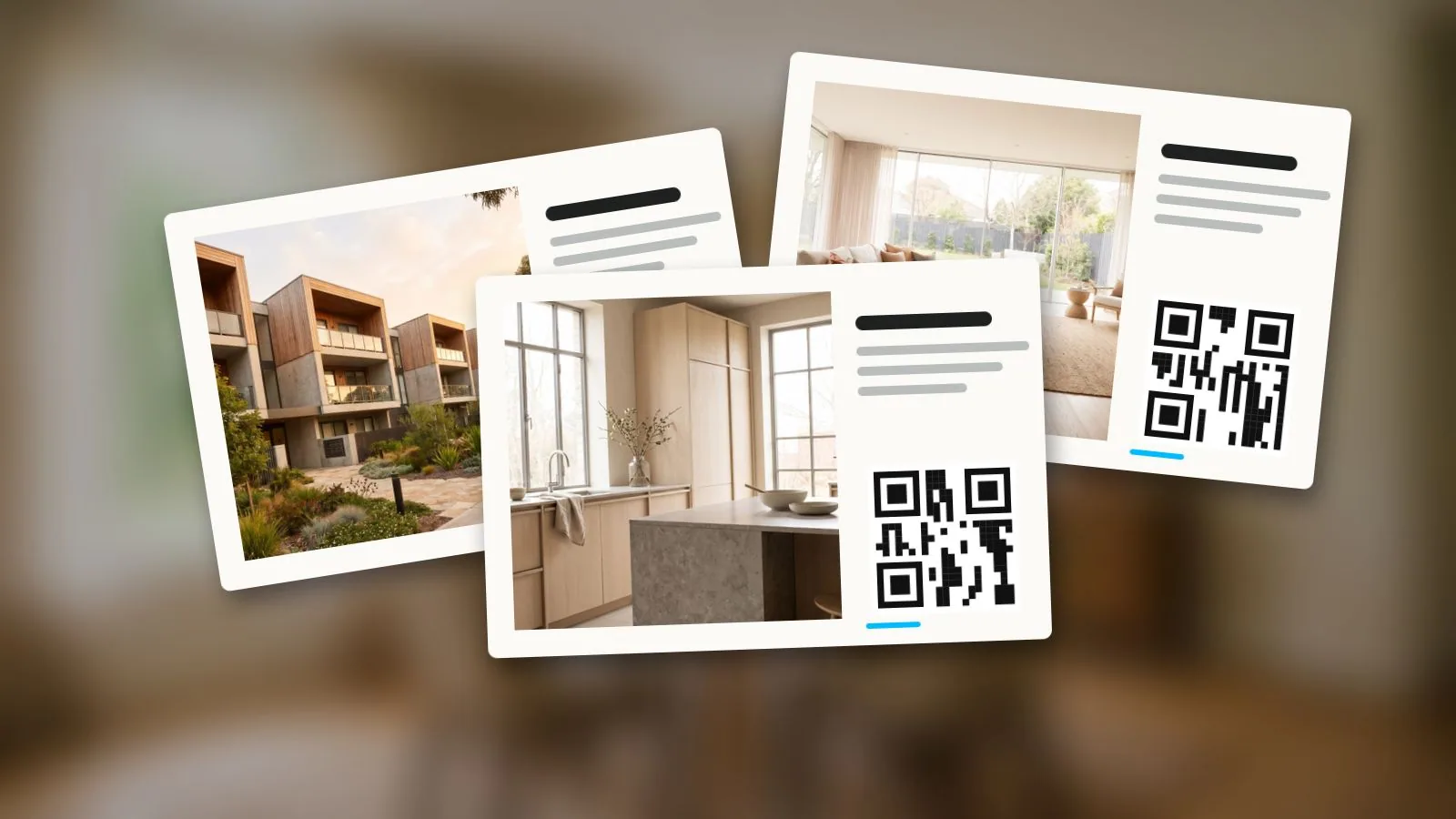
Real estate postcards are one of the cheapest ways to put your name, a home and a reason to call into every mailbox on a street, and they work best when each card has one message and a QR code that leads somewhere useful. Below you will find 12 postcard ideas with an example line for each, the USPS sizes and postage as of November 2026, the design rules that keep a card readable and scannable, and a simple way to tell which card actually brings you sellers.
What real estate postcards are for
A postcard does one of two jobs.
Win sellers in an area. You mail the same streets month after month until owners know your name. A postcard is one of the touches in a real estate farming plan, and one of several ways to get real estate listings.
Stay in touch with people who know you. Past clients, friends and neighbours get a card a few times a year, so your name is the one they think of when someone asks for an agent.
The job decides the mailing list:
- An area: every door on a route, sent through USPS Every Door Direct Mail (EDDM).
- A named list: your past clients or a list of owners, each card stamped and addressed.
Be patient with the area. According to NAR's 2025 Profile of Home Buyers and Sellers, sellers had owned their home for a median of 11 years before selling. So on any street only a few owners are deciding right now. The card speaks to them, and keeps your name ready for everyone else.
12 real estate postcard ideas, with examples
Each idea below has one job, an example line to adapt (the brackets are yours to fill), the page its QR code should open, and the condition that must be true before you mail it.
| Card | What it says | Example line | Where the QR goes | Send it only if |
|---|---|---|---|---|
| 1. Just listed | The home, one photo, the price if the seller agrees | "Just listed on [street]: walk through it from your sofa" | The home's 360 tour | It is your listing, or the listing broker agreed |
| 2. Just sold | One home you sold nearby | "Sold on [street] in [month]. Yours could be next." | Your page of sold homes | You were the listing or the buyer's broker |
| 3. Open house | Date, time, address | "Open house Saturday [date], 1 to 3 pm. See inside first." | The home's tour | The date is fixed |
| 4. Coming soon | A home about to come on the market | "Coming soon to [area]: [bedrooms] bedrooms, garden" | Your profile | Your MLS rules allow it |
| 5. Market update | Homes sold last quarter, median days on market | "[Number] homes sold in [area] this quarter" | Your page of sold homes | The numbers are current and from your MLS |
| 6. What is my home worth? | An offer of a free valuation | "Curious what [street] homes sell for? Ask me for a free valuation." | A contact form, or your phone number | You will deliver a real valuation |
| 7. Thinking of selling | What you will do for the seller, step by step | "Thinking of selling in [area]? Here is my plan, with dates." | Your listing kit page | Every step is true of your service |
| 8. New neighbour welcome | A welcome and a short local list | "Welcome to [area]. Bin day is [day], and here is a plumber I trust." | Your profile | It carries no sales pitch |
| 9. Seasonal home care | A short checklist for the season | "Three jobs before winter: gutters, heating check, outside taps" | Your profile, or a page with the list | The tip is useful on its own |
| 10. Holiday card | A greeting, nothing to sell | "Happy Thanksgiving from [your name] and the team" | None, or your profile | The holiday fits the area |
| 11. Agent introduction | Who you are, your area, one fact | "I am [name], your local agent in [area] since [year]" | Your profile | Every number is yours |
| 12. Home anniversary | A note to a past client | "One year in [street] today. Happy home anniversary!" | Your profile, or a review link | They were your clients |
A few of these deserve more than a row:
- Just sold has its own guide: the wording, who may say "sold" and what needs the seller's yes are all in just sold post. The same rules apply on paper.
- Open house cards work best when the home's tour lets people look before they come. More ways to fill the room are in open house ideas.
- Coming soon has rules of its own in many MLSs: read coming soon real estate before you print one.
- What is my home worth? only works if the valuation is real. Here is how to do a comparative market analysis.
- Agent introduction borrows from your bio, so start with how to write a real estate agent bio.
- Home anniversary is a good moment to ask for an introduction. See how to earn real estate referrals.
Expired and FSBO owners need a personal approach: a letter, or a call only if their number is not on the National Do Not Call Registry. The real estate cold calling script guide has the words and the rules.
One rule covers every card. NAR's 2026 Code of Ethics, binding on NAR members, says in Article 12 that you "shall present a true picture" in your communications. So no "I have a buyer for your home" card unless you have that buyer, and no "sold" claim on a sale you were not part of: Standard of Practice 12-7 limits that to the listing broker and the cooperating broker.
Real estate postcard sizes and postage (USPS, November 2026)
Size decides both the price and who gets the card. These figures were read on USPS pages on 20 November 2026.
| What you send | Size | Postage | Who receives it |
|---|---|---|---|
| Standard postcard, stamped | 3-1/2 x 5 in to 4-1/4 x 6 in, 0.007 to 0.016 in thick | $0.65 postcard stamp | Names on your list |
| Larger card (5 x 7, 6 x 9), stamped | Over the stamped postcard limits; a letter-size piece goes up to 6-1/8 x 11-1/2 in | More than a postcard stamp: check the price for your size | Names on your list |
| EDDM Retail flat | Longer than 10-1/2 in, or taller than 6-1/8 in, or thicker than 1/4 in; up to 3.3 oz | $0.26 a piece | Every address on the routes you choose |
| Presorted First-Class postcards | Up to 6 x 9 in, no thicker than 0.016 in | From $0.453 (automation 5-digit) | Names on your list, through a mailing service |
Where these come from:
- Standard postcards. On usps.com, a standard postcard is 5 to 6 in long, 3-1/2 to 4-1/4 in high and 0.007 to 0.016 in thick, and "a standard postcard stamp costs $0.65." The same page warns that "large or square postcards will cost more."
- Shape. USPS's Domestic Mail Manual, section 201, asks for a rectangle with square corners, and the length divided by the height must be between 1.3 and 2.5. A square card falls outside that, which is why it pays more. The same section caps letter-size pieces at 11-1/2 in long and 6-1/8 in high.
- EDDM. DMM section 143 says EDDM Retail pieces must be flats, as in the table above, and you send 200 to 5,000 pieces per ZIP Code per day. USPS's EDDM page lists $0.26 a piece and no special mailing permit. Postcards, flyers and other EDDM pieces are all USPS Marketing Mail. The real estate flyer guide covers EDDM in more detail, and why unstamped cards never go into mailboxes.
- Presorted rates. USPS's price list effective 4 October 2026 shows lower First-Class prices for presorted postcards, and DMM section 201 lets a postcard at card prices be up to 6 in high and 9 in long, so a 5 x 7 or 6 x 9 card can go at these prices when it is mailed presorted. To qualify, ask your printer or mailing service.
An example sum. 500 stamped standard postcards cost $325 in postage (500 x $0.65). The same 500 homes by EDDM Retail cost $130 (500 x $0.26), but on a bigger card that costs more to print. Prices change, so check usps.com before you set a budget.
How to design a postcard that gets read
One message per card
One home, one date or one offer. The headline says it in under eight words. If a card needs two headlines, it needs to be two cards.
One big photo
The front of the home or its best room, as large as the card allows. The photo is what makes people turn the card over.
A call to action that says what happens
"Scan to walk through it in 360°" or "Scan to see the homes I sold on your street" says what people get. "Call me" does not.
A QR code at a size that scans
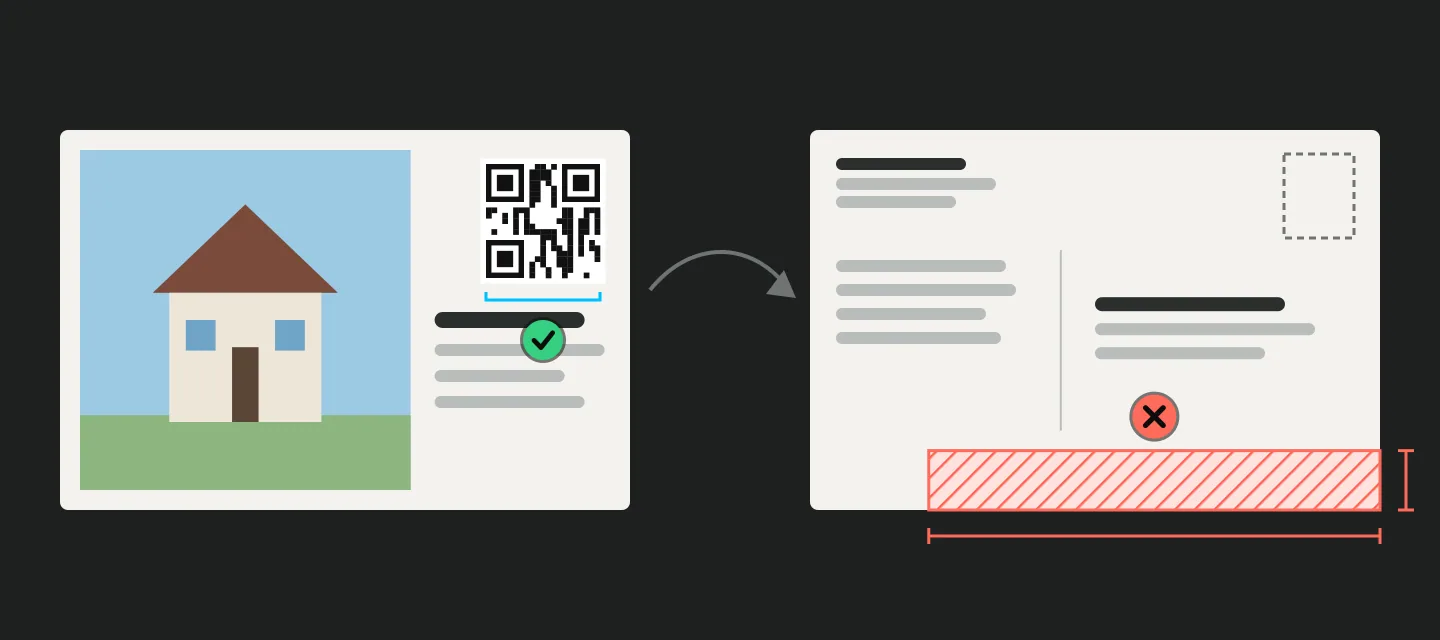
A postcard is read in the hand, about 1 ft away. A common rule of thumb is that a code's width should be at least a tenth of the reading distance, so on a card aim for at least 1.2 in (3 cm). Print it dark on light, keep the white margin around it, and test the printed proof with two different phones before the full run. For window cards and signs, which are read from much further away, see QR codes on real estate signs.
The address side
Put your return address on it, and your firm's name: Standard of Practice 12-5 in NAR's Code asks for it "in a reasonable and readily apparent manner". Then leave the lower right corner alone. USPS's DMM section 202 defines a barcode clear zone there, 4-3/4 in from the right edge and 5/8 in up from the bottom, where printing must meet USPS's reflectance standards. The simplest way to meet them is our advice: print nothing there, and keep the QR code and photos well away.
The words
Describe the home and the area, never the people who should live there. The Fair Housing Act, 42 U.S.C. 3604(c), makes it unlawful to print any notice or advertisement for a home that shows a preference based on race, colour, religion, sex, handicap, familial status or national origin. The just sold post guide has examples of what to avoid.
Where the QR code should lead
Never your home page: a person who scans a card about one home wants that home. Match the page to the card:
- Just listed and open house: the home's 360 tour.
- Just sold and market update: your page of sold homes.
- Thinking of selling: a page made for sellers.
- Introduction and new neighbour: your profile.
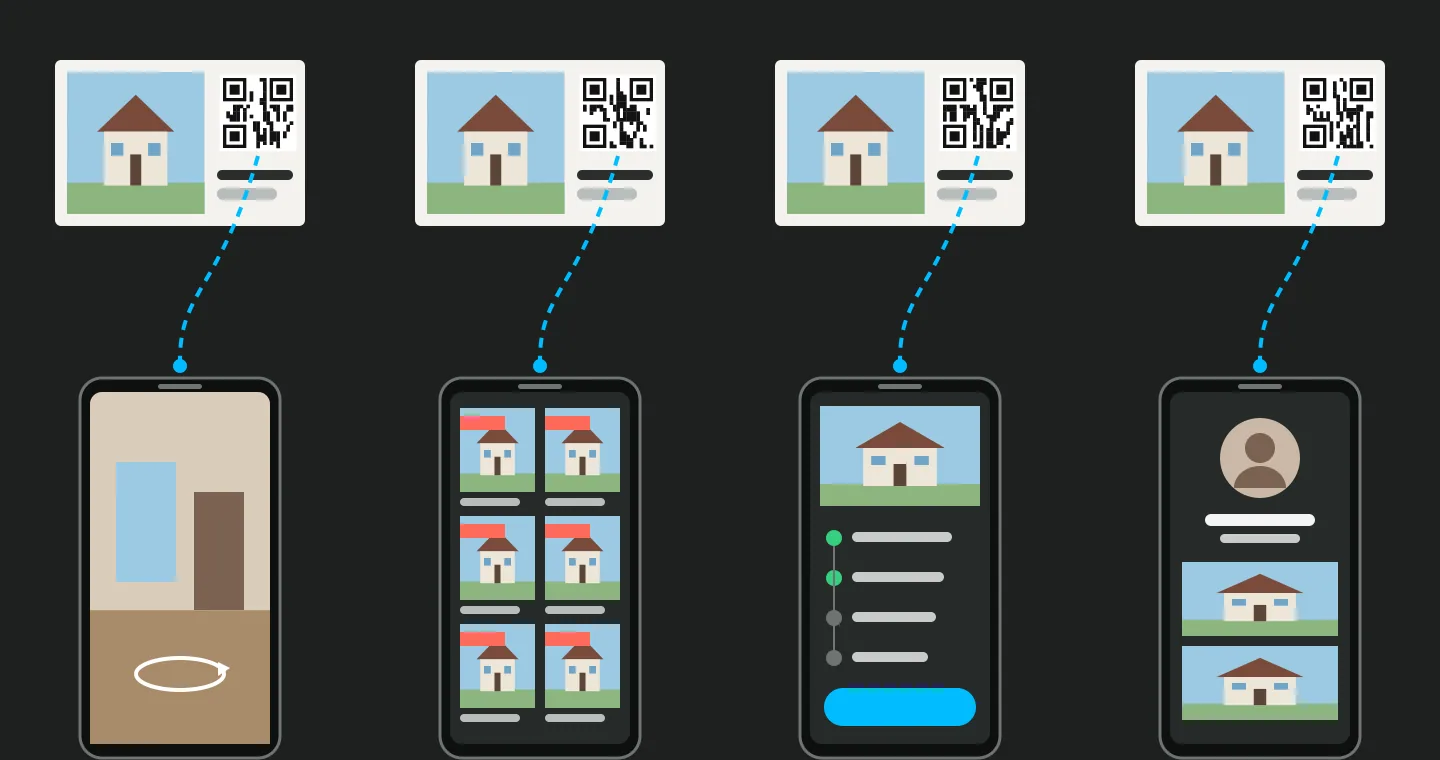
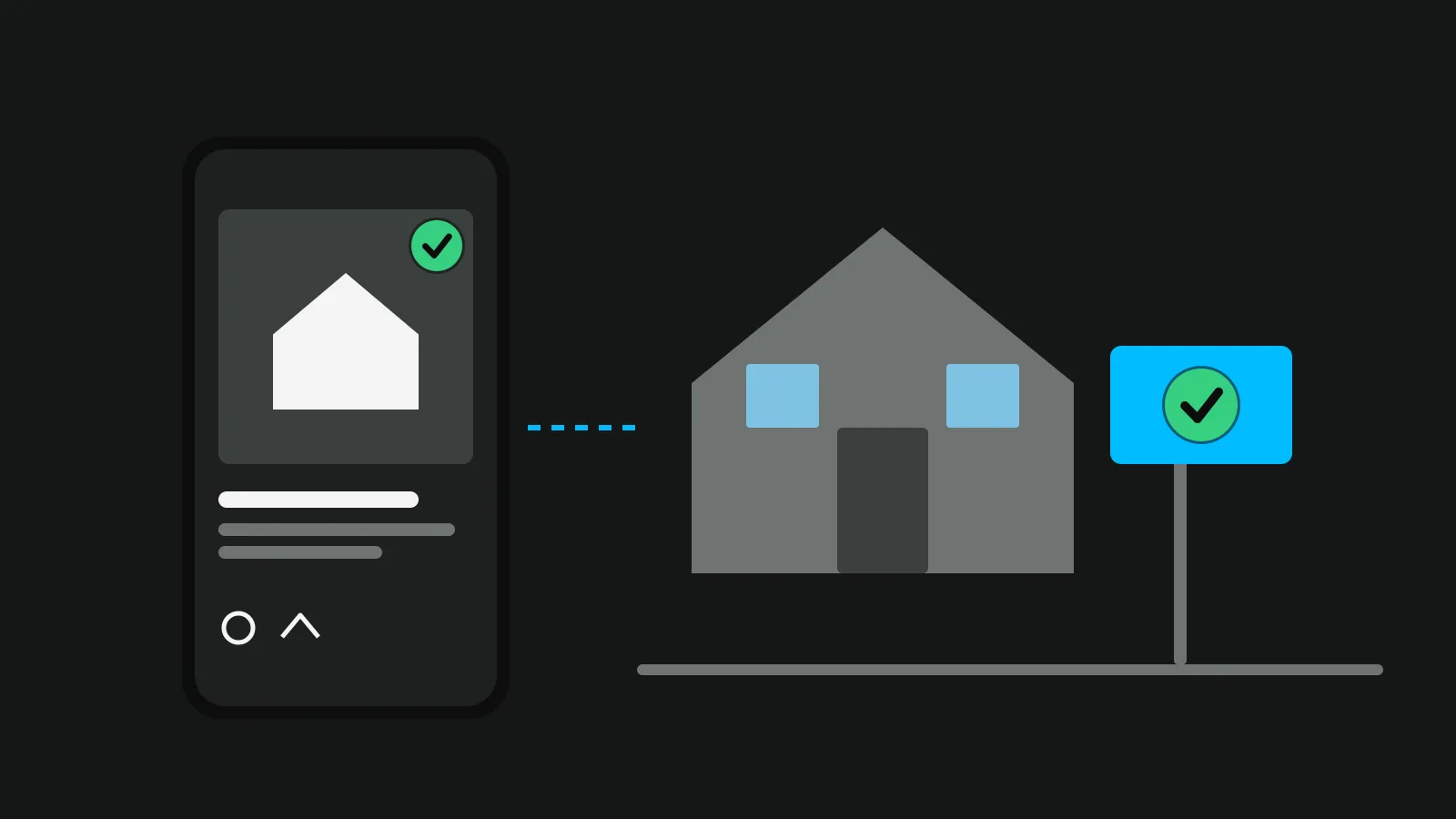
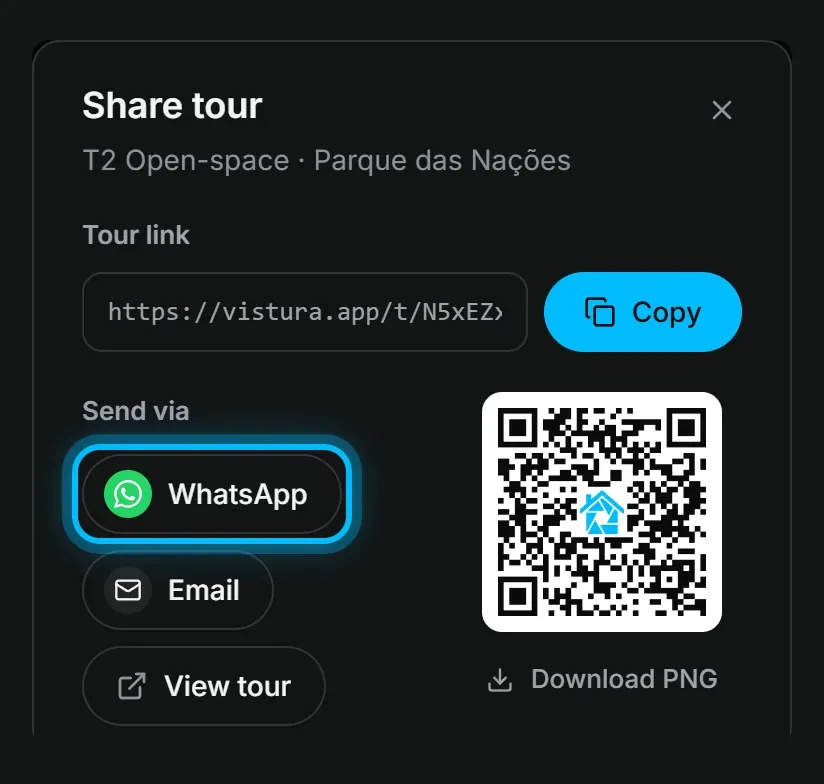
Vistura has the QR code built in. Every tour has its own QR code in the Share window, under "For print and social media": "For shop windows, flyers and for-sale boards." You download it as PNG, PNG with a transparent background, or SVG, which stays "sharp at any size, for print and signs". The code holds the tour's short link, and that link never changes, so a card printed today keeps working. When the home sells, Mark as sold turns the same link into a page that says "This home has been sold", shows your other homes for sale and asks "Looking for something similar?" with a form. Your public profile, with your homes for sale and the ones you sold, has its own QR code under "Share your profile", for the introduction and welcome cards.
The "thinking of selling" card: send owners a page, not a phone number
An owner who is only thinking about selling rarely calls a number on a card. A page read in their own time asks for less.
Vistura's listing kit is that page. In the dashboard, Win your next listing has an Open listing kit button: it gives you a page at vistura.app/@yourname/pitch, made "for the seller before they sign: a tour to walk through, the report they'll get, the homes you sold and your plan with dates", headed "Here's how I'll sell your home", with a "Let's list your home" button. The kit lives on your public profile, so make the profile public first. Copy the kit's link and turn it into a QR code with the free real estate QR code generator: the app gives each tour and your profile their QR codes, and the free tool makes one for any other link. On Pro the page carries your logo and colours instead of Vistura's. The kit pairs well with your listing presentation.
How to tell which postcard brings sellers
Give each card type its own QR code, so each mailing is judged on its own.
- Name each card and month, such as "postcard-listed-nov" or "postcard-market-q1".
- Make one QR code per name. The free real estate QR code tool can add a tag to any link so your own analytics count the scans.
- After each drop, write down the pieces sent, the cost, scans or visits, contacts, appointments and listings won.
- Keep the cards that bring appointments, and change or drop the rest.
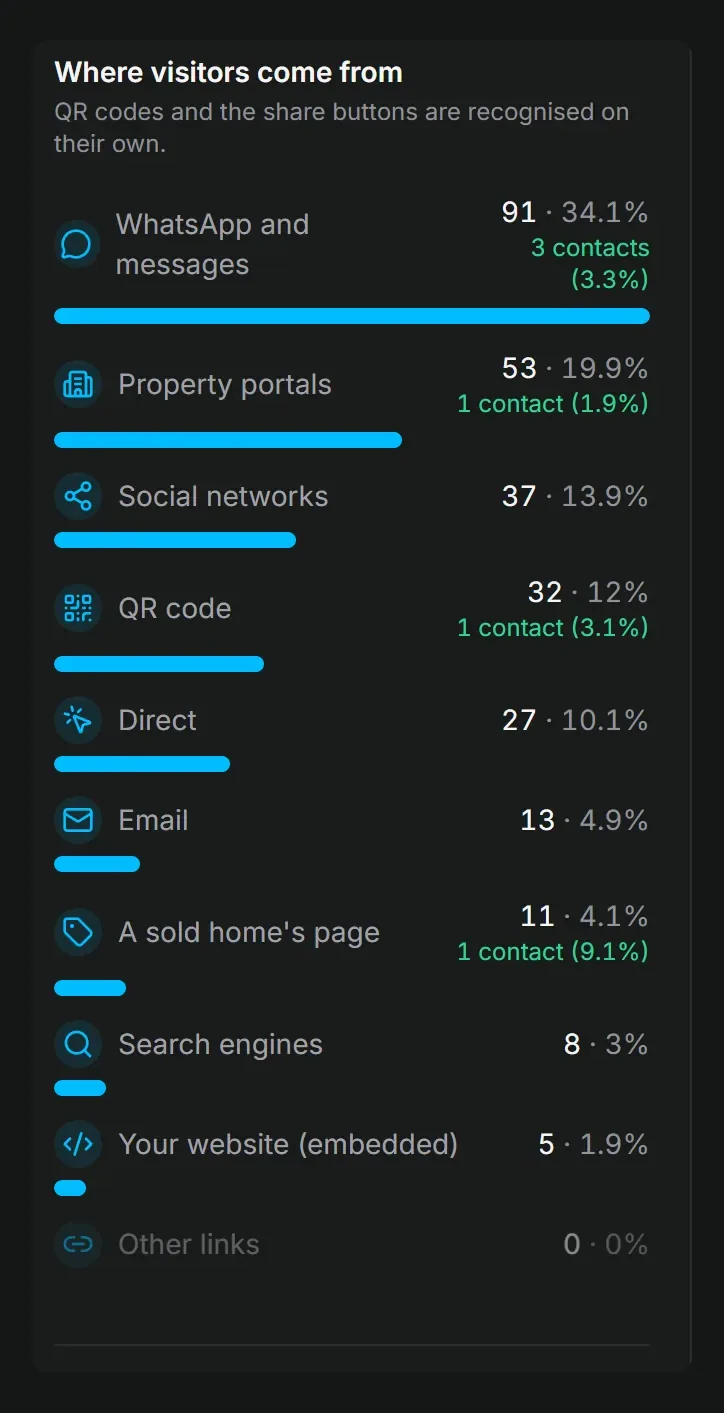
For a tour, Vistura does the counting for you. In the tour's Share window, Link for portals asks "Where will you put this link?": write "Postcard just listed", copy the link and make its QR code with the free tool, leaving the tool's own tag off so the place name stays. On Pro, Statistics then shows that card in its own row under "By portal or place", with the contacts it brought. Codes downloaded from the Share window appear as "QR code" among the places your visitors come from. Visits are counted on every plan; where they come from shows on Pro, and every new account gets 14 days of Pro with no card. See the plans on the pricing page.
Who you can mail, and who to take off the list
NAR's Standard of Practice 16-2 says Article 16 "does not preclude REALTORS® from making general announcements to prospects describing their services", and that holds even where some owners in the area have signed with another agent. A card aimed at one owner who is under contract is another matter.
If someone asks you to stop, take them off the list and note the date. Homeowners can also cut most promotional mail by registering with DMAchoice, as the FTC explains. Unstamped cards never go in mailboxes: the real estate flyer guide explains why. For anything else, check your broker's and your state's rules.
Checklist before you mail
- One message on the card.
- Every claim on it is true.
- Your firm's name is on the card.
- The size is checked against USPS: stamped or EDDM.
- The barcode clear zone on the address side is empty.
- The QR code is 1.2 in (3 cm) or more, and it scans from a printed proof on two phones.
- Each card type has its own tag or QR code.
- The date to read the results is in your diary.
Frequently asked questions
How much does it cost to mail a real estate postcard?
In November 2026, USPS charges $0.65 for a standard postcard stamp and $0.26 a piece for EDDM Retail, which needs a larger card and goes to every address on a route. Printing comes on top, and larger stamped cards cost more, so check the price for your size on usps.com before you print.
What size should a real estate postcard be?
For a stamped card to people on your list, 4 x 6 in is the classic choice: it fits USPS's standard postcard size and its stamp price. For Every Door Direct Mail the card has to count as a flat, so it must be taller than 6-1/8 in or longer than 10-1/2 in.
How often should I send postcards to my farm?
Monthly is the common advice, so the same owners see your name all year. Plan the year as part of a farming calendar and give each month's card one job, such as a listing, a market update or a seasonal tip.
Do real estate postcards still work?
No independent study gives a reliable response rate for agent postcards, so measure your own. Put a different QR code on each card type, then count scans, contacts and appointments per mailing and keep the cards that bring meetings.
Can I mail postcards to homeowners who are listed with another agent?
NAR's Code of Ethics lets members send general announcements describing their services to an area, even if some owners there have signed with another agent. A card aimed at one owner under contract is a different matter, so check with your broker first.