Listing presentation: how to win the seller at the meeting
How to run a listing presentation: the order that works, the net sheet, showing the marketing live on your phone, and the proof you bring that wins the listing.
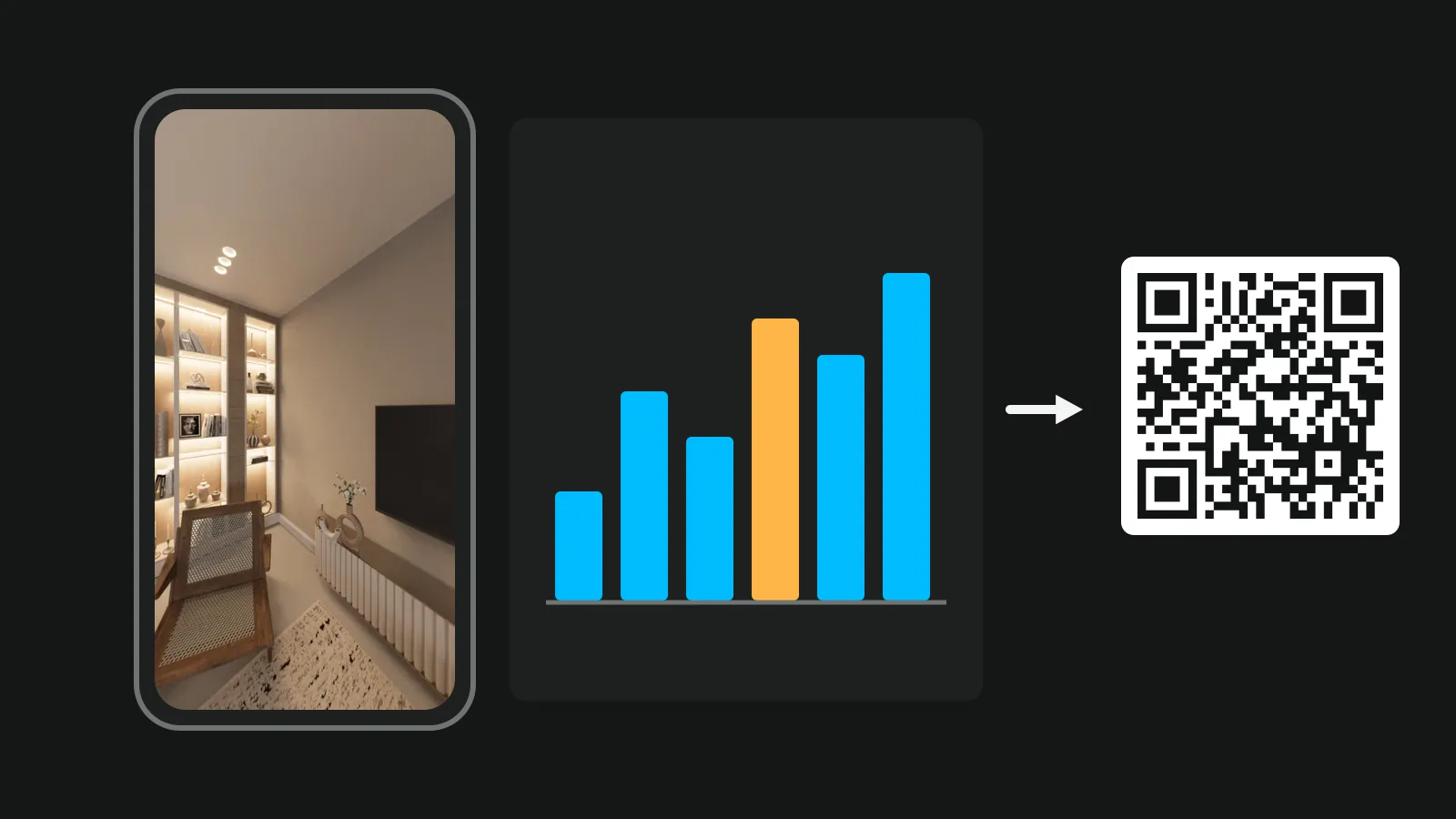
A listing presentation is the meeting where an owner decides whether you will sell their home. It wins when it answers three things about this home: what price, how much the owner keeps, and exactly how buyers will see it. Most slide decks answer a different question, how good your agency is, and that is not what the seller is asking. Use the order below, keep your part short, and let the owner hold your phone with a real tour in it.
Our guide on how to get real estate listings covers how you get to this meeting. This one covers the meeting.
Why the old deck loses
Owners don't sell often. NAR's 2026 profile of buyers and sellers (5 November 2026, US) puts the median at 12 years in the home before selling, an all-time high. Your seller last did this in a different market, with different portals and rules. They also expect an agent: the same report has 92% of sellers using one, so "why use an agent?" is rarely the real question. The real question is "why you?". A deck about your awards doesn't answer that. A plan for their kitchen does.
What to send before you arrive
Keep it to one message the day before. It does three jobs: it confirms the time, it says what you will look at, and it asks for what you can't find yourself.
- Who you are, in two lines, with a link to one home you marketed. One tour they can open on the sofa says more than a brochure.
- What you will do at the meeting: "I'd like to walk the home with you, then show you recent sales nearby, what you would keep at different prices, and how we'd market it."
- What to have at hand, if they can: the latest mortgage statement or the payoff figure, the property tax bill, HOA statements, any energy or repair records, and the date they would like to move.
Asking for the mortgage figure before you meet tells the owner you plan to talk about their money, and it lets you fill in the net sheet properly. Some won't share it, and that's fine: leave the line empty and fill it in together. Don't send your price in advance. It depends on what you see, and a number on a screen gets compared with no context.
Prepare your own side too: three recent sales, not asking prices; the homes currently competing for the same buyers; and a tour open on your phone, ready to hand over.
The order that works
- Ask first (5 minutes). Why are they selling, by when, what would make it a good result, who else decides? Write down their words.
- Walk the home with them. Point out what buyers will ask about. It's the moment you see the things that change your price.
- Price, with three sales. Show recent comparable sales in the area, not asking prices, and a range. Give the number you would list at, and why.
- What they keep. A filled-in net sheet: price, commissions, taxes, payoff. See our guide to the cost to sell a house for the lines. It is what the owner is calculating in their head while you talk.
- How buyers will see it. Show the marketing on your phone, not on a slide.
- How you will report. Show a sample and a date. Then stop talking, and ask for the decision.
Steps 1 and 2 should take longer than steps 3 to 6 together.
Show the marketing, don't describe it
"Professional photos and a virtual tour" appears in every proposal. So hand over the phone. Open a 360 tour from a home you marketed, and let the seller walk through it room by room, without your help. In a Vistura tour that takes one link. Then say what it does for them: buyers who ask for a showing have already seen the layout, so fewer strangers walk through the home for nothing.

Put the plan next to it in writing, with dates:
| When | What the seller gets |
|---|---|
| Before going live | Photos and 360 tour, with their approval |
| Launch day | Listing live, tour link sent to your buyer list |
| Same week | Sign and flyers with a QR code that opens the tour |
| Every week | A report with visits and enquiries, plus your note |
| Day 30 | A date to review the price together |
Dates turn a promise into something the seller can check.
Bring a report the seller can picture
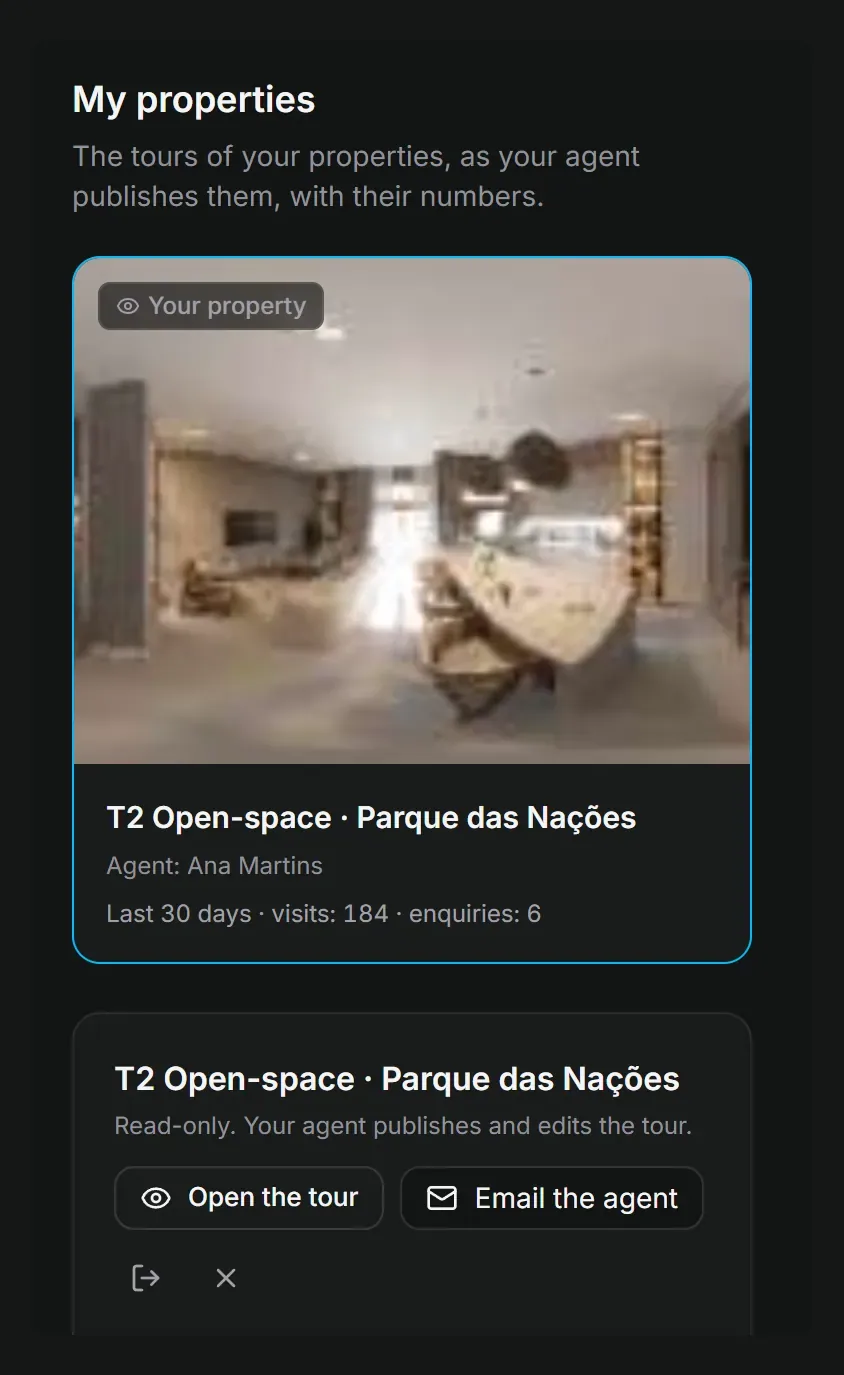
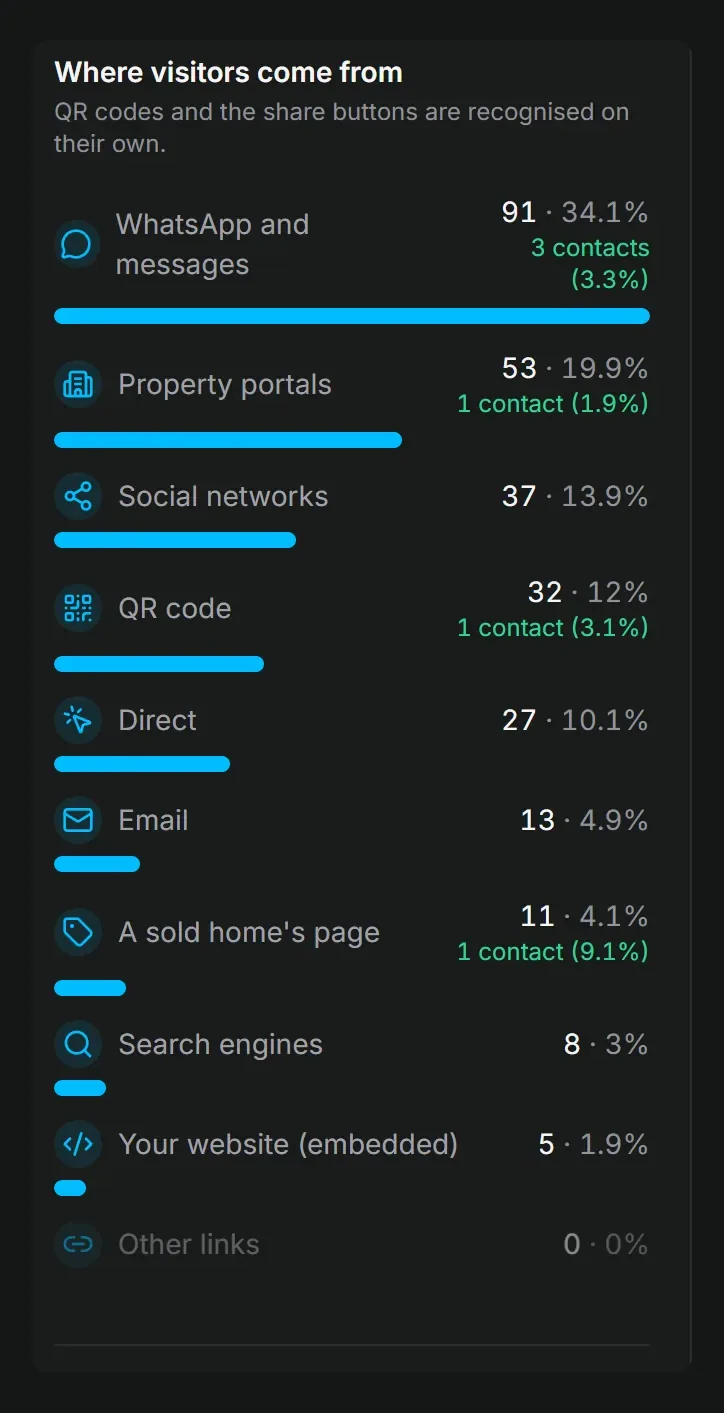
Many sellers worry they will hear nothing after signing. So answer that before they sign: show what they will receive each week, using another home's numbers with the owner's name removed. On Pro, Vistura's "Owner report" sends the owner, by email or as a PDF, the tour's visits, time, where visitors came from, most-seen rooms and contact requests, with your own note and your brand. Owner access gives them a read-only page for their home with its numbers, and never shows who the buyers are.
The source breakdown is what turns a report into an argument. If the numbers say visits come from your QR sign and your buyer messages, not only the portal, the seller sees that the marketing you promised is really happening.
Say the awkward things before they do
- Commission. In the US, NAR's settlement FAQ (5 September 2024) has members disclose in conspicuous language that commissions "are not set by law and are fully negotiable", and get approval for any payment to a buyer's representative. So raise it yourself, and show what the fee pays for. Rules differ elsewhere, and the listing agreement is what counts.
- "Another agent says more." Don't argue. Put your three sales on the table and ask which sales they used. A higher number with no sales behind it loses on its own, usually a few weeks later.
- "We want to try alone first." The same NAR report puts for-sale-by-owner at 5% of sellers. Don't quote that as pressure. Offer the report and the plan, and ask to come back on a set date.
- "Let us think about it." Good. Ask what they still need, send it the same day with the plan and the net sheet, and agree when you will call.
After you leave
Send a one-page summary within a few hours: their goals in their words, your price and why, their net, the plan with dates. Keep it short enough to read on a phone. A made-up example for a seller moving to be near family:
What you told me: You want to move by June, and you'd rather not have viewings every evening while the children are at home.
Price: I'd list at $450,000. The three closest recent sales were $438,000, $452,000 and $461,000; yours has the newer kitchen and the smaller yard.
What you would keep: about $207,750 at that price before any tax on the gain, using the lines on the attached sheet. At $440,000 it is about $198,360.
Plan: photos and tour by 3 March, for your approval. Live on 6 March. A report every Monday. We review the price together on 5 April.
What I need from you: the exact payoff figure from your lender, and a yes or no by Friday.
Notice what is missing: your agency's history. Each line is something they told you or something you will do, with a date. The summary also reaches anyone who decides with them and was not at the table. If they sign with someone else, ask what decided it, and write it down. After a few of these you will know which part of your meeting needs work. And if you win, keep the dates. It's how this listing brings the next one.
Frequently asked questions
How long should a listing presentation be?
As short as the seller's questions allow. Plan for the seller to talk first, keep your own part to about 20 minutes, and stop when they have what they need to decide.
Should I send my listing presentation before the meeting?
Send who you are and one example of your work. Keep the price and the plan for the meeting, because both depend on what you see in the home and hear from the seller.
How do I answer "another agent charges less"?
Ask what is included in that fee, then show your written plan and your report beside it. Commission is negotiable, so talk about it openly. Compare what the seller gets, not just the percentage.
Can I use another client's tour as an example?
Use a tour that is public and that the client agreed to share, or one from a home that has been sold if your agreement with that client allows it. Never show their contact details or the buyers' details.