Real Estate Farming: How to Pick an Area and a 12-Month Plan
Real estate farming step by step: choose a farm area with the turnover formula, a 12-month touch plan, mail costs, the rules and how to measure each piece.
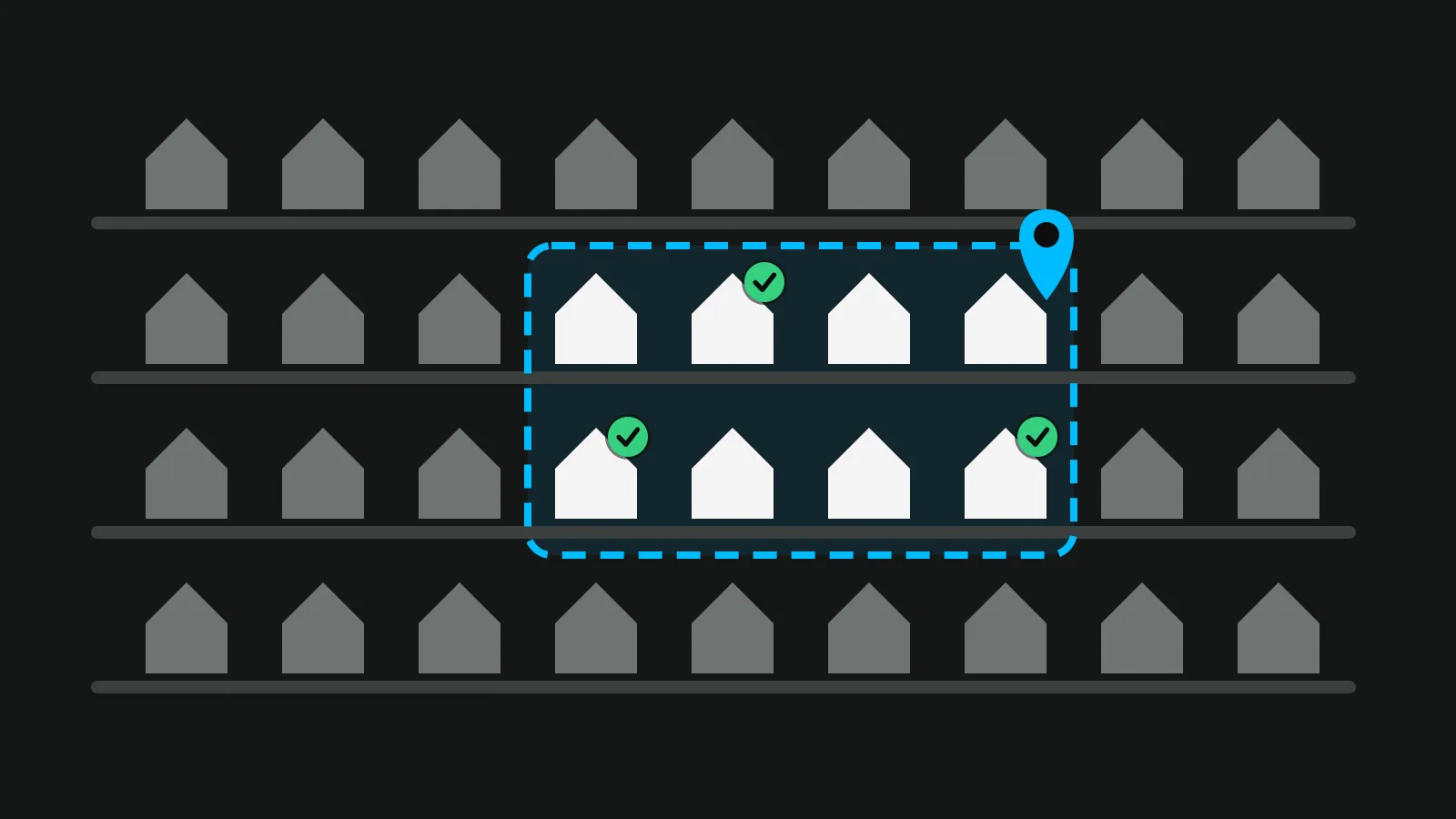
Real estate farming means picking one neighbourhood and staying in front of its homeowners, month after month, until you are the agent they call when they decide to sell. It usually takes about a year before it pays, so the choice of area matters more than any single postcard. This guide shows how to choose the area, what to send each month, what it costs, the rules for mail, doors and phone, and how to tell if it works.
What real estate farming is (and what it is not)
Geographic farming is the classic version: one area, every home in it, the same agent's name again and again. A "demographic farm" picks a group instead of a place, such as first-time buyers or local landlords. This guide covers the geographic kind.
Farming wins sellers, not buyers. It is a listing strategy, and how to get real estate listings gives the short version of it as its first step. Buyer enquiries are a different job, covered in real estate lead generation.
Why it works: home sellers have owned their home for a median of 11 years before selling, according to NAR's 2025 Profile of Home Buyers and Sellers. In any year, only a few owners in your farm will decide to move. The farm is about being the name they remember at that moment.
How to choose your farm area
Turnover rate
Turnover tells you how many chances an area gives you each year:
Turnover rate = homes sold in the last 12 months ÷ homes in the area × 100
An example with two areas near an agent's office:
| Area A | Area B | |
|---|---|---|
| Homes in the area | 600 | 900 |
| Homes sold in the last 12 months | 36 | 27 |
| Turnover rate | 6% | 3% |
Area A gives more sales with fewer doors to reach, so it costs less per chance. Coaching guides quote floors between 5% and 8%, and HousingWire's guide uses 6%. These are rules of thumb, not data: use the formula to compare your own options.
Where the numbers come from: homes sold from your MLS or county records; homes in the area from the US Census Bureau, which publishes housing data by ZIP Code Tabulation Area. A whole ZIP is usually too big for one farm, so for a smaller patch, count the homes street by street on a map.
Competition
Look at who listed last year's sales. If one agent or office took most of them, that area already has its agent. Choose somewhere else, or a smaller patch next to it where nobody dominates.
Price band and your income
Pick homes you can list and sell well, at a price where one commission pays for a year of farming. Use your own numbers:
Yearly farm cost ÷ your net commission per sale = sales you need to break even
If the answer is more than one sale a year in a new farm, the area is too expensive for you, or the farm is too big.
Size
Start with what you can touch every month by mail and visit in person. One industry guide, HousingWire's, suggests 250 to 500 homes for a first farm. You can grow later; a farm you cannot keep up with is wasted money.
Somewhere you can be seen
Choose an area near your home or office, where you shop and walk the dog, and where you can hold an open house. Being seen in the street does part of the work the mail does.
Your 12-month farming plan
Plan the year before you send anything. Every touch has a QR code or short link that leads to something useful, such as a tour of a home in the area or your page of sold homes, not your home page.
| Month | Touch | What it says | Where it leads |
|---|---|---|---|
| 1 | Introduction letter | Who you are, why this area, one useful fact about it | Your page of homes for sale and sold |
| 2 | Market note | Homes sold, median days on market, from your MLS | Your page of sold homes |
| 3 | Just listed or just sold postcard | One home in the area and its result | The home's tour |
| 4 | Door knocking day with a door hanger | An offer to tell owners what their home would sell for | Your contact form |
| 5 | Open house invitation | Date, time, address | The home's tour |
| 6 | Mid-year market note | Sales so far this year, compared with last year | Your page of sold homes |
| 7 | Seasonal useful piece (an idea: a list of local contractors) | Something owners keep on the fridge | Your contact form |
| 8 | Just sold postcard | The sale, the story in one line | Your page of sold homes |
| 9 | A small local event | An invitation: coffee, a talk on selling, a park clean-up | A sign-up page |
| 10 | Market note | The autumn numbers | Your page of sold homes |
| 11 | Door hanger or holiday card | Thanks, and a reminder you are local | Your contact form |
| 12 | Year in review | What sold in the area, what you did there | Your page of sold homes |
For the postcards, see how to write a just sold post: the same sale works on social media and on the doormat. For the open house month, pick from these open house ideas.
Run digital touches alongside the mail: posts in local Facebook groups where the group rules allow it, posts on your Google Business Profile, and email to the owners who gave you their address and agreed to hear from you (see real estate email marketing).
With Vistura, every tour comes with its own QR code and short link, so a just listed card leads straight into the home's 360 tour. After the sale, "Mark as sold" in the tour's menu keeps that code working: anyone who scans last spring's postcard sees a page that says "This home has been sold", with a "Sold" stamp, up to six of your homes still for sale (with your profile public) and a "Looking for something similar?" form that lands in your Leads. Your public profile at vistura.app/@yourname shows those homes apart, under "Recently sold", and sold listings stay there with no limit. That is the track record your farm sees.
What to send: mail, door hangers and the rules
USPS Every Door Direct Mail delivers to every address on the routes you choose. With EDDM Retail you need no special mailing permit, you send at least 200 and up to 5,000 pieces per day per ZIP Code, and in November 2026 postage for flats was $0.26 a piece. Check your card with USPS's Mailpiece Size Checker before you print.
For a farm of 500 homes that is about $130 in postage per drop, before printing, and about $1,560 for 12 monthly drops. Prices change, so check the current one on usps.com when you budget.
Never put unstamped flyers in mailboxes: it is against federal law, as the real estate flyer guide explains.
At the door
Hang the door hanger on the handle or hand it over in person. Respect "No soliciting" signs, and check your city's rules on door-to-door soliciting and permits before your first door knocking day: they differ from town to town.
By phone
If you phone owners in your farm, the FTC's Telemarketing Sales Rule applies. You must sync your call lists with the National Do Not Call Registry every 31 days, and calls outside 8 a.m. to 9 p.m. local time break the rule. The exceptions are narrow: someone who did business with you in the last 18 months, or asked you about something in the last three months. States add their own rules on calls and texts, so ask your broker before you start.
QR codes on print
Size and placement matter more than design: see how big to print a QR code. For a link that is not a tour, the free real estate QR code tool makes one with no account.
Sphere of influence: the farm you already have
Your real estate sphere of influence is the people who already know you: past clients, neighbours, friends, family, people from work or school. They get the same touches as the farm, made more personal: a handwritten note instead of a postcard, a call on the anniversary of their purchase. When one of them asks a question, answer it one to one, as in replying to a new enquiry. A sphere often brings the first listing in a new farm, through someone who lives there.
How to measure your farm
Give every touch its own tag, made of the type and the month: "postcard-nov", "door-hanger-mar", "openhouse-may". Put a different QR code or short link on each piece, so you know which one people scanned.
After each drop, write down five numbers:
| Cost | Pieces | Scans and visits | Contacts | Appointments |
|---|---|---|---|---|
| What you paid for print and postage | How many went out | People who scanned or opened the link | People who wrote or called | Listing appointments booked |
Add a sixth column at the end of the year: listings won. Cost divided by appointments gives you the cost per appointment, the number that decides whether the farm is worth it.
In Vistura, "Link for portals" lets you name each place where a tour's link goes, so a postcard, a door hanger and a local group each get their own tagged link, and QR code visits are recognised on their own. Every plan counts the visits; on Pro, Statistics show visits and contacts by place and by source, so you see which mailer brought people in, and the data is kept, so the breakdown is there when you upgrade. Contacts land in your Leads with their details; on Pro you move them through stages (New, Contacted, Visit booked, Offer, Won, Lost) and set "Follow up on" so no owner from the farm waits a week for an answer.
When to keep going and when to quit an area
This part is judgement, not data. Review the farm after 12 months of monthly touches and ask:
- Are people recognising you? Calls, replies, scans and visits should be going up over the year.
- Have you had listing appointments in the area?
- Did one agent still take nearly every listing?
- Does the cost per appointment fit your commission?
Signals to move on: no listing appointments after a full year, turnover fell, or the price band no longer fits your business. When you move, shrink rather than drop: keep the streets where people know you, and keep your sold homes there as proof.
Show sellers what the marketing did
When you win a listing in your farm, show the seller what you did for it. Vistura's owner report can be downloaded as a PDF or sent by email: on every plan it shows the visits and contact requests, and on Pro it adds where visitors came from, the rooms they looked at most, time in the tour and your logo. It fits into your next listing presentation as proof for the street. Every new account gets 14 days of Pro with no card, and Pro has unlimited tours online; see the plans.
Checklist
- Area chosen with the turnover formula and a look at the competition
- Size you can reach every month by mail and in person
- 12 touches planned in a table
- Yearly budget and the sales you need to break even
- A tag, QR code or short link per touch
- Do Not Call Registry checked, if you phone
- Your city's door-to-door rules checked
- The 12-month review in your diary
Frequently asked questions
How long does real estate farming take to work?
Plan on about a year. That is the rule of thumb in coaching guides and industry articles, not a measured figure. Homeowners sell rarely, so the first months are about being recognised; listing appointments tend to come once people have seen your name every month for a while.
How many homes should be in a farm area?
Start with as many as you can reach every month by mail and visit in person on a door knocking day. Industry guides suggest 250 to 500 homes for a first farm. A whole ZIP Code is usually too big to touch often enough on one agent's budget.
What is a good turnover rate for a farm?
Coaches quote floors between 5% and 8% a year. Treat those as rules of thumb and use the formula to compare your options instead: homes sold in the last 12 months divided by homes in the area, times 100. Between two areas you could serve equally well, the higher rate gives you more chances per door.
How much does real estate farming cost?
Mostly postage, printing and your time. With USPS Every Door Direct Mail Retail, postage for flats was $0.26 a piece in November 2026, so 500 homes cost about $130 a drop before printing. Check the current price on usps.com before you budget.
What is the difference between farming and sphere of influence?
Your sphere of influence is the people who already know you: past clients, friends, family, neighbours. A farm is a place: every home in an area you choose, most of whose owners have never met you. Many agents work both, with more personal touches for the sphere.