Exclusive Right to Sell: The Listing Agreement Explained
What an exclusive right to sell listing agreement contains, how it differs from exclusive agency and open listings, and how to get the owner to sign it.
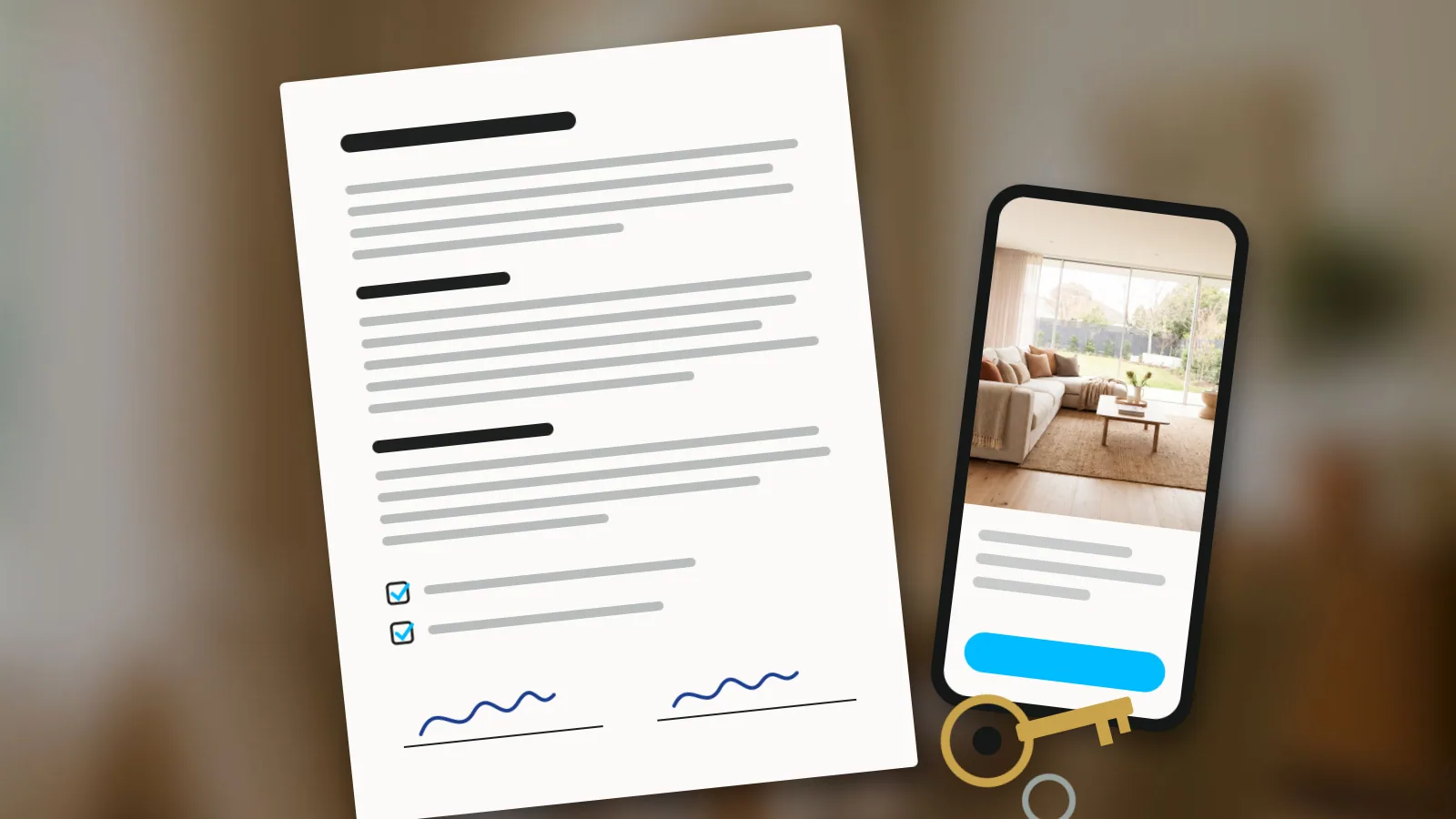
An exclusive right to sell listing agreement is a written contract in which a home seller gives one agent the sole right to market the home for a set period, and agrees to pay the agreed fee if the home sells during that period, whoever finds the buyer: the agent, another agent or the seller. It gives the agent a reason to invest in the marketing, because the work will be paid. To get it signed, show the seller in writing what they get in return: a dated plan, the marketing and a weekly report.
This guide covers the three types of listing agreement, what an exclusive right to sell agreement contains, the rules that vary by state, and how to get the owner to sign.
The three types of listing agreement
| Exclusive right to sell | Exclusive agency | Open listing | |
|---|---|---|---|
| How many agents | One | One | Any number |
| Owner sells to a buyer they found alone | Fee still due | No fee | No fee |
| What the agent can invest | The most: the work will be paid | Less: the owner may sell around them | Little: any agent may get the sale |
The terms are used in plain language across the US, but the exact definitions come from your state's law and your MLS rules. Read the form your brokerage uses, not a summary.
In England and Wales the law gives fixed meanings to similar terms. Under "sole selling rights", the fee is due even if the buyer was found "by any other person, including yourself", and under "sole agency" the fee is due for a buyer introduced by the agent or by another agent during the period, according to the Schedule of the Estate Agents (Provision of Information) Regulations 1991, as originally made. Agents who use those terms must explain them in the contract.
What an exclusive right to sell listing agreement contains
Every brokerage has its own form, and your state decides what is mandatory. A good agreement covers these points, and the seller should understand each one before signing.
The parties and the property
The seller (every owner who must sign), the brokerage and the agent, and the property described precisely: address and, where your form asks for it, the legal description.
The price and terms
The list price and the terms the seller will accept. Florida, for example, requires the "price and terms" in every written listing agreement under Fla. Stat. 475.25(1)(r).
The fee and when it is due
The commission or flat fee, and the exact event that makes it payable. Commissions are negotiable: since 17 August 2024, NAR requires REALTORS and MLS participants working with sellers to state conspicuously in the listing agreement that broker commissions are not set by law and are fully negotiable (NAR). Since the same date, offers of compensation to buyer brokers are no longer allowed on the MLS; sellers can still offer them off the MLS. NAR's practice changes also require the listing agent to disclose to the seller, and get the seller's approval for, any payment or offer of payment to an agent acting for a buyer (NAR settlement FAQ). Put that decision in writing, for example in the agreement.
In England and Wales, section 18 of the Estate Agents Act 1979 requires the agent to tell the client, before the client is committed, when the fee becomes payable and how much it is or how it will be calculated. If the agent fails to do so, the agent cannot enforce the contract without a court order.
The term
A start date and a definite end date. Florida requires a definite expiration date in every written listing agreement, and the agreement may not require the seller to notify the broker that they intend to cancel after that date. Other states have their own rules; your brokerage's form follows yours.
What happens after the term
Your form may add a protection period: if the home sells after the agreement ends to a buyer who saw it during the term, the fee may still be due. Whether that is allowed, and for how long, depends on your state and your form. Explain it to the seller in one sentence, with the number of days your form says.
What the agent will do
Rules like Florida's do not require this part, and that is why it wins listings. Write down the services: photos and a virtual tour, where the home will be advertised, viewings, open houses, and how often the seller gets a report. The seller is giving you exclusivity; this is what they get back.
Signatures and a copy
Every owner signs, and gets a copy. Florida requires the copy to be given within 24 hours.
Exclusive right to sell vs the buyer agreement
Since 17 August 2024, NAR's practice changes require MLS participants working with a buyer to sign a written agreement with that buyer before touring a home, in person or by live virtual tour, according to NAR's consumer guide. That is a separate contract, with the buyer. The exclusive right to sell is the seller's side. Do not mix the two in your conversation with the owner.
How to get the owner to sign an exclusive listing agreement
Sellers hesitate for one reason: they fear being tied to an agent who then does nothing. Every objection to exclusivity is a version of that fear. Answer it with things they can see and check.
Show the plan, with dates
"I will market your home well" is a promise. "Photos and the 360 tour on Tuesday 24, live on the portals on Thursday 26, a sign with a QR code on Monday 30, your first report the week after, and a price review together on Monday 28 December" is a plan. Bring it written, with dates counted from the day they sign. The listing presentation guide covers how to show it in the meeting.
Show the marketing before they sign
Send them a home you are selling now, the way buyers see it: the photos, the virtual tour, the listing. A seller who has walked through one of your tours on their phone does not need you to describe your marketing.
Offer the report in exchange for exclusivity
This is the trade that works best: "You give me the exclusive. I give you a report every week: how many people looked at your home online, where they came from, the rooms they looked at, the enquiries and the viewings, and what I did." Show a sample before they sign. See what to put in a weekly seller report.
Make the term fit the plan
A seller signs a term more easily when it matches the plan you showed them, with a price review inside it. If they still hesitate, a shorter first term with the option to extend costs you little when you are confident in your work. Check what your brokerage allows.
Answer the three common objections
- "I'd rather list with several agents." "Then no agent can afford to invest in your home, and buyers see it at different prices on different sites. With one agent, you get one plan, one price and one person accountable."
- "What if I find a buyer myself?" Explain the clause honestly. If it is a deal breaker, an exclusive agency agreement may be the answer: say what changes in your marketing.
- "What if you do nothing?" "Then you will see it in the report every week, and we have the review date in the plan."
For more ways to reach sellers before this meeting, see how to get real estate listings.
Show the seller what they get with Vistura
In Vistura, the dashboard card "Win your next listing" opens your listing kit: one page for the seller, at your public profile's address (vistura.app/@yourname/pitch), that you send before the meeting or open on your phone at the kitchen table. It shows, in order:
- A real tour to walk through: one of your homes on sale, opened in 360 on their phone.
- "Your plan, with dates": photos and tour, going live, the sign and flyers with a QR code, the first report and a price review, each with a weekday and date counted from the day they open the page.
- A sample owner report, clearly marked as example numbers, so they see what they will get each week.
- The homes you have sold, each with its photo, and buttons to reach you by WhatsApp, phone or email.
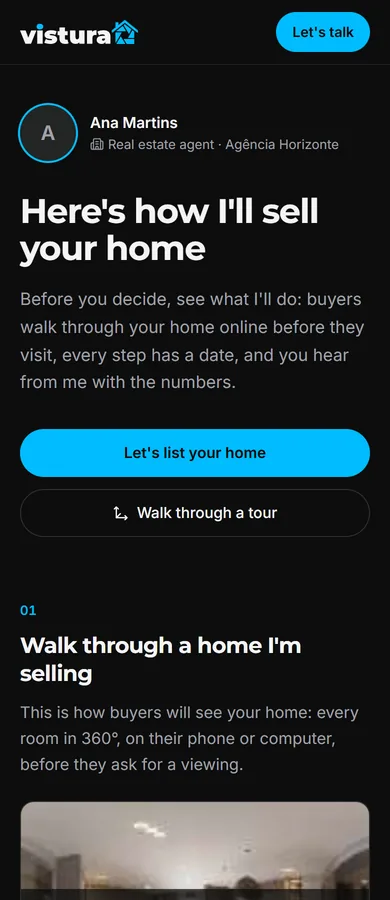
Under "Change the words and the plan" you set the title, your message to the seller, the tour, how many days after signing the home goes live, and whether the report is weekly or monthly. "Copy link" shares it, "Open full screen" shows it at the table, and "Download PDF" prints it. The help guide Win a listing with your listing kit walks through every setting.
On Pro, the page carries your logo and colours, the plan includes the owner's own page to follow their home, and the sample report shows everything a Pro report holds. After the signature, the real owner report keeps the promise: you choose the period, write what you did and press "Send now". Every new account gets 14 days of Pro with no card: see pricing.
Before you sign: a checklist
- Every owner is named and will sign.
- The price, the fee and the event that makes the fee due are written in full.
- The end date is a date, not "until sold".
- Any protection period is explained in one sentence.
- The services and the report are written down.
- The seller has read the form your brokerage uses, and you have answered every question.
- Your broker has approved anything you changed.
The rules in this guide are those in force on 21 November 2026: Florida Statutes 475.25, NAR's practice changes of 17 August 2024 and, for England and Wales, the Estate Agents Act 1979 and its 1991 Regulations. If your brokerage's form is older, check that it follows the current version.
Frequently asked questions
What does exclusive right to sell mean in real estate?
The owner gives one agent the sole right to market the home for a set period and agrees to pay the agreed fee if it sells in that period, even if another agent or the owner finds the buyer. In return, the agent commits to marketing the home.
What is the difference between exclusive right to sell and exclusive agency?
Under an exclusive agency listing, the owner keeps the right to sell to a buyer they find on their own without paying the fee. Under an exclusive right to sell, the fee is due whoever finds the buyer during the term.
How long does an exclusive right to sell agreement last?
As long as the agreement says. Rules vary by state. Florida, for example, requires a definite expiration date in every written listing agreement, and the agreement may not require the seller to notify the broker that they intend to cancel after that date. Agree a term long enough to market the home properly, within your state's rules.
Is the commission in a listing agreement fixed?
No. Commissions are not set by law and are fully negotiable, and NAR requires listing agreements used by REALTORS and MLS participants to say so. The agreement should state the fee and the event that makes it due.
Why would a seller sign an exclusive listing agreement?
Because one agent who knows they will be paid for the work puts more into the marketing, and the seller has one person accountable for it. Agents earn the signature by putting their services in writing: a dated plan, the marketing they will do and the report the seller will get every week.